
The engine light comes on, the dashboard displays “engine fault,” and the car struggles to exceed 100 km/h uphill. A check with the OBD scanner reveals code P2563. On a Peugeot diesel, this code appears frequently, but its actual meaning is less obvious than it seems.
Turbo actuator and control loop: what P2563 really indicates
The P2563 code does not point to a specific broken part. It indicates that the engine control unit detects a discrepancy between the position it commands the turbo actuator to take and the position reported back by the sensor. In simple terms, the control unit says “open the vanes to 40%,” the sensor responds “they are at 12%,” and the system records an inconsistency.
This distinction is crucial. P2563 is a consistency fault, not an electrical cut-off. The sensor is functioning; it sends a signal, but this signal does not match what the control unit expects. The fault could originate from the sensor itself, the actuator, the variable geometry of the turbo, or even a purely software issue.
Before attempting to interpret the P2563 fault code for Peugeot, it is essential to keep in mind that this code encompasses several very different scenarios.
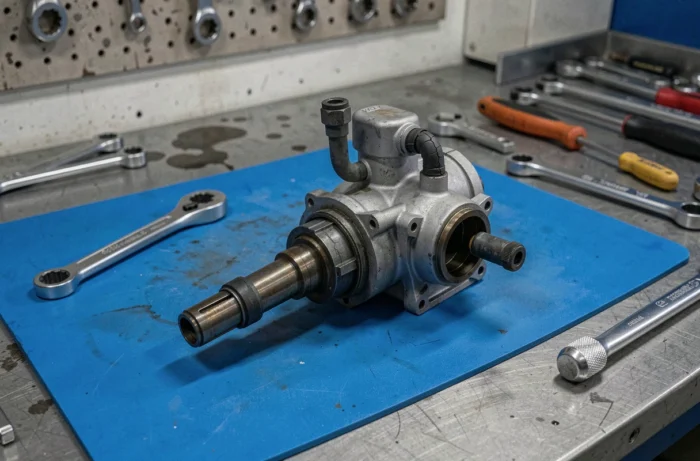
Clogged variable geometry: the most common cause on Peugeot HDi engines
On the 1.6 HDi and e-HDi engines found in Peugeot 207, 308, or 3008 models, the turbocharger uses movable vanes (variable geometry) to adjust the boost pressure according to the engine speed. These vanes are immersed in exhaust gases laden with soot.
Over time, soot builds up on the vanes and in the turbo’s central housing. The vanes become difficult to move. The actuator struggles to shift them, but can no longer reach the position requested by the control unit. The sensor accurately measures this actual position, and the discrepancy triggers the P2563 code.
Soot contamination is the primary cause of P2563 on Peugeot diesels. A technical report from the TH group shows photos of completely clogged geometries on turbos returned to the workshop with this fault code. The turbo was not dead; its vanes were simply stuck.
Cleaning or replacing the turbo
When the geometry is clogged without mechanical wear on the bearings, a professional cleaning of the turbo may suffice. The turbo is removed, disassembled, the vanes and housing cleaned, then reassembled and tested. This intervention costs significantly less than a complete turbo replacement.
However, if the bearings show play or if the turbine shaft is damaged, replacement becomes necessary. The current trend in specialized workshops is to replace only the actuator before condemning the entire turbo, which helps avoid an unnecessarily hefty bill.
Calibration of the actuator after repair: the step many forget
You have replaced the actuator or the entire turbo, cleared the fault codes, and yet P2563 reappears a few kilometers later. This scenario is common, and the reason is often the same: the recalibration procedure has not been performed.
On turbos with electronic actuators, the engine control unit must “relearn” the reference positions of the actuator after any intervention. This procedure, sometimes referred to as “actuator adaptation,” requires a diagnostic tool capable of communicating with the control unit to initiate a learning sequence.
Without recalibration, the control unit compares the positions to old values that no longer correspond. The sensor works, the actuator does too, but the control unit’s reference is outdated. The result: a phantom P2563 on otherwise new equipment.
This point is rarely mentioned in forums, yet it fundamentally changes the approach to diagnosis. A P2563 code after repair does not mean the new part is defective. It may simply mean that the software procedure has not been completed.
Other electrical causes to check
Before suspecting the turbo or the actuator, a methodical diagnosis involves checking the electrical circuit. Here are the points to prioritize:
- The actuator connector: a corroded or poorly clipped connector is enough to distort the position sensor signal, especially in humid weather
- The wiring harness between the actuator and the control unit: the wires run close to the exhaust manifold and can deteriorate with heat
- The control solenoid (on pneumatic control systems): a cracked hose or a stuck solenoid prevents the actuator from reaching the correct position
A multimeter and a thorough visual inspection can help eliminate these causes before incurring heavier expenses.

Symptoms of P2563 on Peugeot: what you feel behind the wheel
The P2563 code does not always manifest in the same way depending on the state of the turbo and driving conditions.
- Marked loss of power, especially uphill or during hard acceleration, with the engine seeming “restricted” beyond a certain RPM
- Engine light on steadily, sometimes accompanied by the message “engine fault, please repair the vehicle” on the dashboard
- Difficult hot starting, while cold starting remains normal
- Whistling or unusually dull noise from the turbo, indicating that the geometry is not positioning correctly
- Entering limp mode: the control unit intentionally limits power to protect the engine
Entering limp mode is a sign that the control unit no longer trusts the turbo. Driving in this state does not damage the engine in the short term, but the loss of power makes driving uncomfortable, even dangerous on the highway or during overtaking.
P2563 Diagnosis: why the scanner alone is not enough
Connecting an OBD tool and reading “P2563” only provides a starting point. The code indicates that there is a positional discrepancy, but not why. A good diagnosis requires reading the real-time values of the position sensor while the engine is running, to observe whether the signal moves, remains fixed, or oscillates erratically.
Comparing the commanded position and the measured position in real-time allows you to determine if the actuator responds partially, not at all, or with a delay. It is this comparison that points towards clogging, an electrical fault, or a calibration issue.
A mechanic who replaces a turbo solely based on the P2563 code risks changing a part that was still functioning. Real-time diagnostics prevent unnecessary replacements.