
The menstrual swimsuit is taking an increasing place on textile shelves and specialized websites. Its manufacturing relies on an assembly of technical layers, each serving a specific function, from absorbing flow to waterproofing in aquatic environments. Understanding the design stages allows one to measure what distinguishes a reliable product from a simple lined swimsuit.
Chlorine and UV Resistance: Tests That Classic Menstrual Underwear Do Not Undergo
A menstrual swimsuit is not a menstrual panty that one would wear at the pool. The constraints related to chlorinated water, seawater, and prolonged exposure to ultraviolet rays require specific validations from the prototyping phase.
Protocols such as the AATCC 162 test (color resistance to chlorinated water) or the ISO 105-E03 standard for chlorine dye fastness are used to verify that the fabric does not degrade after dozens of simulated washes. Some manufacturers subject their materials to prolonged immersion at a concentration of 3 ppm of chlorine for about a hundred hours, then check the residual elasticity and the adhesion of the waterproof film to the fabric.
Without these steps, a prototype may seem functional during initial tests but then deteriorate quickly. The waterproof film peels off, the waistband distorts, and the colors fade. Those considering creating a menstrual swimsuit with Mode Sign will find a structured framework to integrate these constraints right from the textile specifications.
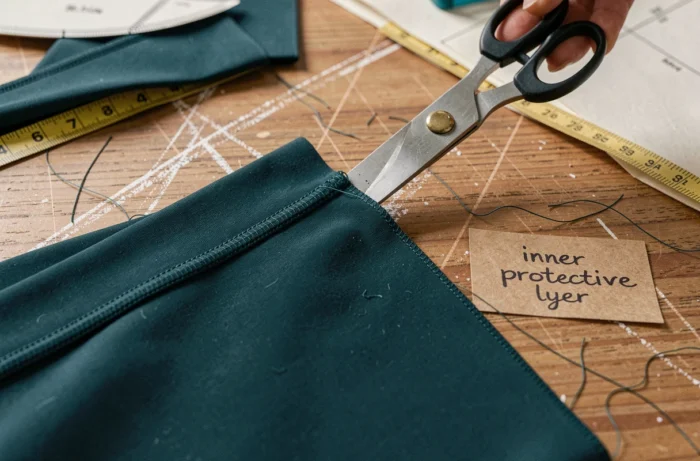
Multilayer Assembly of a Menstrual Swimsuit: Materials and Functions
The manufacturing relies on a stack of three layers, each selected for a specific property. The choice of materials at this stage determines the effectiveness of the finished product in real conditions.
Inner Layer in Contact with the Skin
This first layer uses hydrophilic fibers capable of quickly capturing the flow and transferring it to the absorbent layer located beneath. It must remain soft, thin, and dry quickly to avoid any prolonged feeling of dampness. Quick-drying synthetic materials are preferred, sometimes combined with an antimicrobial treatment.
Intermediate Absorbent Layer
This is the technical core of the swimsuit. This layer retains the flow without swelling in contact with water, which differentiates it from a classic sanitary pad. The fibers used must selectively absorb menstrual blood without soaking up pool or seawater. The weight and density of this layer vary according to the desired absorption capacity.
Outer Waterproof Membrane
A waterproof film, often laminated onto the outer fabric, prevents any leaks to the outside. This membrane must withstand the pressure exerted by water during swimming, repeated movements, and accelerated aging due to chlorine and salt. The visible fabric mimics the appearance of a classic swimsuit to ensure discretion.
- The inner layer captures and transfers the flow without retaining moisture from the surrounding water
- The absorbent layer selectively retains menstrual blood without swelling, even when submerged
- The waterproof membrane blocks leaks while maintaining flexibility and breathability out of the water
- The outer fabric ensures a visual appearance identical to a standard swimsuit
PFAS-Free Manufacturing: A Regulatory Constraint That Has Become Central
Per- and polyfluoroalkyl substances (PFAS) have long been used in water-repellent and waterproof treatments for textiles. Since 2025-2026, European restrictions on PFAS are profoundly changing the choice of materials for any product in prolonged contact with skin and mucous membranes.
For a menstrual swimsuit, this means that the waterproof film and surface treatments must be reformulated. Alternatives exist (TPU membranes, fluorine-free coatings), but their performance in chlorinated aquatic environments requires additional validations. Field feedback varies on this point: some TPU membranes perform as well as the old fluorinated formulations after several dozen wash cycles, while others show signs of delamination earlier.
The Oeko-Tex Standard 100 certification, often mentioned by brands, certifies the absence of harmful substances in the finished product. It does not cover the mechanical performance of the textile in water. Chemical certification and functional validation are two distinct steps that should not be confused during development.

Prototyping and Field Validation: Where the Reliability of the Menstrual Swimsuit Is Tested
An assembled prototype in the workshop is not enough. The testing phase in real conditions (chlorinated pool, seawater, prolonged wear) reveals defects that are invisible on the cutting table.
- The maintenance of elasticity after about fifty simulated washes in chlorinated water, to verify that the fit remains stable
- The absence of color migration after exposure to UV and salt, tested according to standardized protocols
- The behavior of the waterproof membrane under hydrostatic pressure, replicating active swimming conditions
Testing campaigns also integrate perceived comfort: feeling of dryness, freedom of movement, visual discretion under wet clothing. A menstrual swimsuit that absorbs properly but visibly swells at the crotch will not be worn, regardless of its technical performance.
Feedback from users in varied conditions (light to medium flow, short or prolonged swimming, fresh or saltwater) allows for adjustments to the absorbent weight and the positioning of seams. This iteration between prototyping and field testing often represents the longest phase of development.
Manufacturing a reliable menstrual swimsuit is not just about layering three pieces of fabric. Each material must be validated individually, then in assembly, against constraints that classic menstrual protections never face: chlorine, salt, UV, water pressure. Regulatory developments regarding PFAS add an additional variable that pushes manufacturers to rethink their formulations without immediate guarantees of functional equivalence.