
An embroidered beanie featuring a logo or text is not just an aesthetic choice. The material of the knit, the density of the embroidery thread, the compliance of the labeling, and the new French environmental obligations all influence the final result as much as the design itself. Before approving a visual, several technical parameters deserve close examination.
Material constraints and weight: what happens under the embroidery needle
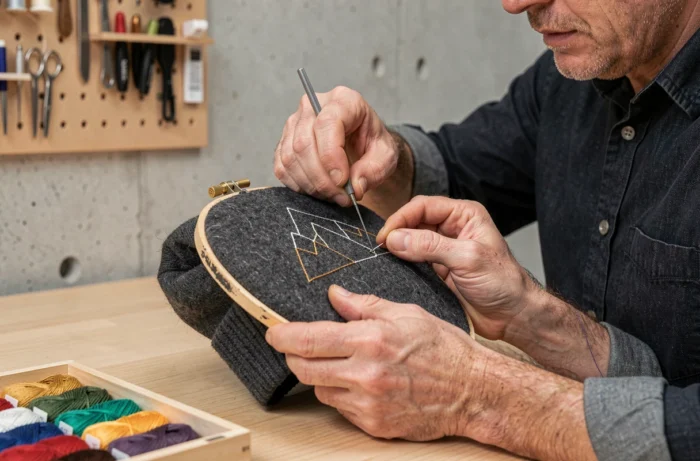
Embroidery on a beanie is quite different from embroidery on a flat t-shirt. The knit is stretchy, often ribbed, and the fabric deforms under the tension of the embroidery frame. A weight that is too light causes visible puckering around the design, especially on fine letters or details smaller than a few millimeters.
Acrylic remains the most common fiber for promotional beanies. It accepts embroidery well due to its dimensional stability after washing. Recycled polyester is gaining ground, but its smoother knits sometimes require reinforced interfacing to prevent the thread from slipping.
Organic cotton, offered by several textile customization workshops, provides a softer touch. However, its knit absorbs more moisture, which can loosen the fabric around the embroidered area after a few washes. For those looking to customize an embroidered beanie in organic cotton, a wash shrinkage test before mass production helps avoid unpleasant surprises.
Design choice and technical limits of embroidery on beanies
The embroiderable surface on a beanie is limited. The usable front area rarely exceeds ten centimeters in height, and the curvature of the head complicates wide designs. A logo designed for a square format does not work as is on a beanie.
Three parameters determine the readability of the final result:
- The density of stitches per square centimeter: if too high, it stiffens the fabric and creates a cardboard effect. If too low, the knit shows through the threads.
- The number of colors: each thread change adds machine time and multiplies the risks of misalignment. Beyond four or five colors, costs increase and clarity decreases on ribbed knit.
- The minimum character size: fonts with fine serifs lose their readability below a certain letter height. Sans-serif fonts remain more reliable on knit.
Before approving a file, requesting a stitched sample on the same batch of beanies as the final production remains the safest method. Field feedback varies on this point: some suppliers offer digital simulations deemed sufficient, while others swear by the physical sample.
Textile labeling and environmental product sheet: what changes for customized beanies
Customizing a beanie does not exempt one from adhering to textile labeling rules. The fiber composition, country of manufacture, and care instructions must be included on a sewn or integrated label. The composition label remains mandatory even for small promotional volumes.
Since January 2025, the obligation for an environmental product sheet has expanded in France to a much larger portion of the textile market. Companies exceeding a certain revenue threshold must now provide precise information: geographical traceability of manufacturing stages, percentage of recycled material, recyclability of the product, and even risks related to plastic microfibers or hazardous substances.
For an embroidered beanie distributed in France, this means that the client must obtain this data from their supplier. An embroidery workshop that works on a custom basis does not always provide traceability for the blank beanie it embroiders. Checking this point in advance helps avoid unknowingly being in violation.
Anti-fast fashion law and online display
Starting January 1, 2027, advertising for products in the so-called ultra-fast fashion will be banned in France. Online sales platforms will also need to clearly and legibly display the manufacturing locations. If a customized beanie is made outside the European Union and then embroidered in France, the mention of the manufacturing location of the blank beanie must be distinct from that of the embroidery location.
The available data does not yet allow for conclusions on the exact application modalities for small volumes or one-off orders. The implementing decrees will specify the thresholds and display formats. In the meantime, keeping the supplier’s traceability documentation is a reasonable precaution.
Embroidery, flocking, or transfer: what marking for what use of the beanie
Embroidery is not the only marking technique applicable to a beanie, but it is the most durable. The embroidered thread withstands repeated washes and retains its relief. Flocking (cut velvet transfer) offers a matte and uniform finish, suitable for solid colors, but it does not age as well on a stretchy knit.
Screen printing and digital transfer allow for four-color visuals, with gradients impossible in embroidery. Conversely, they add a waterproof layer to the textile that alters the breathability of the beanie. For daily winter use, this detail matters.
- Embroidery: maximum durability, raised finish, ideal for simple logos and short texts.
- Flocking: velvet appearance, good for wide letters, less resistant to abrasion.
- Digital transfer: photo-realistic reproduction, but plastic feel and reduced breathability.
The choice of marking depends as much on the intended use as on the desired visual. A beanie distributed at an outdoor sporting event does not have the same constraints as a beanie sold as a fashion accessory.
Textile customization is becoming more complex in terms of regulations. Material, marking technique, and environmental compliance form a triptych that online competitors rarely address together. Cross-referencing these three dimensions from the outset remains the most reliable way to obtain an embroidered beanie that lives up to its promises, both on the head and on the label.