
Between a dog’s nose and a piece of meat that is starting to spoil, the game is played in a few milliseconds. The dog perceives volatile organic compounds of decomposition at concentrations that our noses can’t even suspect. Understanding this mechanism allows us to measure how much the canine sense of smell serves as a natural health filter, but also to identify its limits when faced with certain foodborne pathogens.
Volatile organic compounds and canine detection thresholds
When meat degrades, bacteria produce gaseous molecules: putrescine, cadaverine, biogenic amines, short-chain fatty acids. These volatile organic compounds (VOCs) form an olfactory profile that the dog detects long before a smell becomes perceptible to a human.
The olfactory epithelium of the dog covers a surface area significantly larger than that of humans. This biological architecture gives it access to extremely low detection thresholds, which explains why a dog recoils from a piece of chicken left at room temperature while its owner does not yet smell anything.
The Australian biosecurity program illustrates this capability in operational conditions. The Australian Department of Agriculture trains dogs to precisely identify odors from animal products (raw meats, charcuterie, dried products) in travelers’ luggage.
These dogs discriminate between permitted products and prohibited products based on specific olfactory profiles of meat and meat derivatives. An in-depth article discusses spoiled meat in dogs on Amazing Pet Place and details the behavioral mechanisms associated with this detection.
| Olfactory signal | Human perception | Canine perception |
|---|---|---|
| Putrescine / cadaverine | Detected only at high concentrations (strong smell) | Detected in the early stages of bacterial degradation |
| Biogenic amines | Perceived late, often masked by other odors | Identified even in a mixture of complex odors |
| Short-chain volatile fatty acids | Associated with a rancid smell, perceived after several hours | Spotted early, triggering avoidance behavior |
This table summarizes the fundamental gap: the dog detects degradation before the meat smells bad to us.
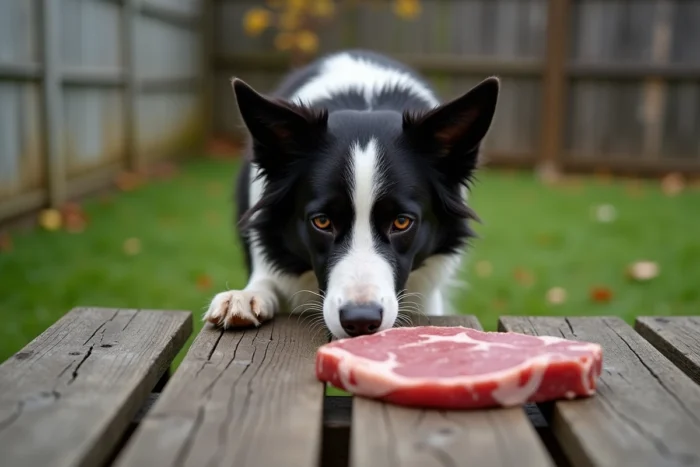
Avoidance behavior in dogs faced with spoiled food
Detection is not enough. The dog must also translate the olfactory information into appropriate behavior. In most cases, a dog confronted with a source of VOCs from decomposition shows a recoil, a turning of the head, or sniffs for a long time without consuming.
This reflex relies on a circuit where the vomeronasal organ and the main olfactory bulb work in parallel. One analyzes classic volatile molecules, while the other captures heavier chemical signals. Together, they provide the dog with a three-dimensional olfactory image of what is in front of it.
However, this filter is not infallible. Some dogs, particularly those breeds with a voracious appetite or animals accustomed to rummaging through trash, may ingest spoiled meat despite the warning signals. The American Kennel Club (AKC) confirms that dogs can develop food poisoning after ingesting contaminated food, with symptoms comparable to those observed in humans.
Behavioral signals to watch for after suspected ingestion
- Repeated vomiting within hours of the meal, indicating a rapid gastric reaction to bacterial toxins
- Watery or bloody diarrhea, indicating potentially serious intestinal irritation requiring veterinary advice
- Sudden lethargy and refusal to eat, indicating systemic discomfort expressed by the dog through withdrawal
- Tremors or excessive salivation, possible neurological symptoms in case of ingestion of toxins such as those produced by Clostridium botulinum
Electronic noses and biosecurity: the dog as a technological reference
Researchers are developing electronic sensors inspired by the canine olfactory system to detect food degradation. These devices, sometimes referred to as “electronic noses,” aim to replicate the dog’s ability to identify specific VOCs in complex matrices.
However, the approach is still far from matching canine versatility. An electronic nose operates on a panel of sensors calibrated for specific molecules. The dog, on the other hand, processes hundreds of compounds simultaneously and adapts its response to the context. In the Australian biosecurity program, detection dogs work on odor matrices that combine raw meat, processed meat, and dried products, a complexity that artificial sensors struggle to manage.
This comparison highlights a often overlooked point: the domestic dog sniffing its bowl mobilizes the same sensory apparatus used in professional food safety contexts. The difference lies in training and conditioned response, not in basic capability.
Real limits of the dog’s olfactory protection
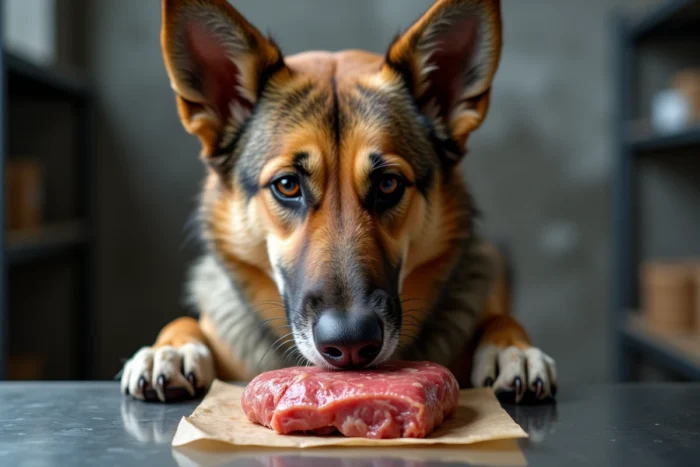
A dog’s sense of smell does not protect it from everything. Some pathogenic bacteria (Salmonella, E. coli, Listeria) can contaminate meat without producing detectable VOCs in the early stages of colonization. A contaminated piece of meat may smell “normal” to the dog and still trigger an infection.
Cooking eliminates most pathogens, but dogs often consume raw meat or inadequately cooked leftovers. The BARF diet, which is gaining popularity, exposes dogs to bacterial risks that their sense of smell does not always compensate for.
Factors that reduce the reliability of the olfactory filter
- Bacterial contamination without visible or olfactory organoleptic degradation, common with Salmonella on fresh poultry
- Chronic nasal conditions (rhinitis, tumors) that silently decrease the dog’s olfactory sensitivity
- Aging: older dogs gradually lose their olfactory acuity, reducing their ability to discriminate degraded foods
Consulting a veterinarian remains the appropriate response in case of doubt about suspected ingestion. The canine sense of smell is a remarkable first line of defense, but it does not replace human control of the cold chain and food freshness. The dog detects decomposition better than any terrestrial mammal, but the most dangerous pathogens sometimes advance masked.