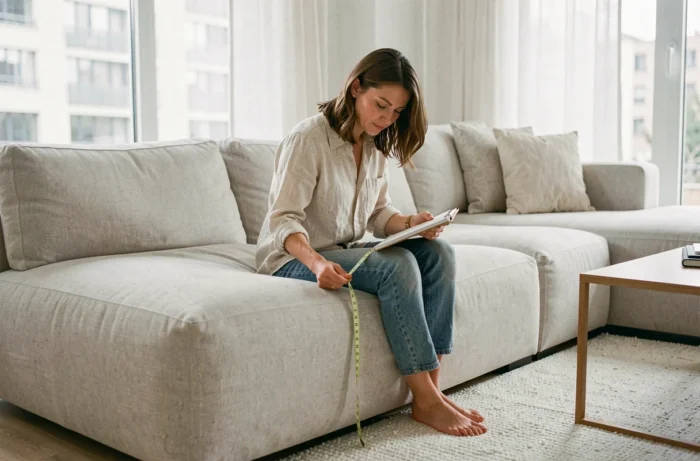
A sofa that is too wide blocks the passage to the kitchen. A model that is too short floats in the middle of the wall. Choosing the size of a sofa is not just a matter of taste: it is primarily a matter of centimeters, measured in the right place, in the right direction.
Passage width and diagonal: what the living room area doesn’t tell you
Have you ever measured your living room in square meters to choose a sofa? This reflex is logical, but it overlooks a crucial parameter: the route between the front door and the living room. A generous corner sofa may suit a spacious living area, but get stuck in the stairwell on delivery day.
In modern homes, internal circulation must measure at least 90 cm wide to comply with accessibility standards. Design professionals recommend a corridor width of 100 to 110 cm for real comfort, and 120 cm if two people need to pass each other without effort.
For winding stairs or angled corridors, remember to measure the available diagonal at each turn, not just the width. It is this diagonal that determines the maximum transportable size of the sofa to its final location. Before consulting a catalog, it is useful to know the dimensions of a sofa to compare the measurements of the desired model with those of your home.
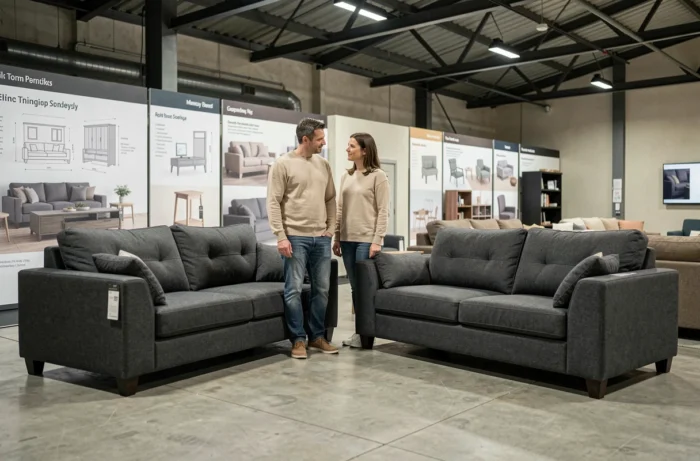
Seat depth and setback: the measurements that change sofa comfort
The length of the sofa captures all the attention. The depth, on the other hand, often takes a back seat. Yet it is the measurement that most influences your posture and circulation in the room.
Seat depth according to your morphology
A sofa with a shallow seat (about 50 cm) is suitable for shorter individuals: their feet touch the ground, and their back rests against the backrest. A more generous seat appeals to larger frames who enjoy sitting cross-legged or semi-reclined.
Test the seat by sitting all the way back, feet flat. If your knees clearly extend beyond the edge, the seat is too short. If your back no longer touches the backrest, it is too deep. This test is better than any matching chart.
Setback from the wall and coffee table
A sofa pushed against a wall seems to save space. In reality, most models need a few centimeters of setback so that the back cushions are not compressed. Also, allow sufficient distance between the edge of the seat and the coffee table to get up without contorting: the recommended range is between 35 and 45 cm.
The total depth of the sofa plus the wall setback determines the remaining space for circulation in front. If this passage drops below 70 cm, the room becomes uncomfortable for daily use.
Sofa shapes and living room layout
The choice between a straight sofa, a chaise longue, or a corner sofa does not depend solely on the area. The shape of the room, the location of windows, and the position of doors are equally important.
- A two or three-seater straight sofa fits well in long living rooms where only one wall offers enough setback. It leaves room to add a chair facing it or a side table.
- A sofa with a chaise longue works well in medium-sized rooms, provided the elongated part is placed on the side opposite the main passage. If the chaise longue blocks access to the window or corridor, the comfort gained in seating is lost in circulation.
- A corner sofa is suitable for large open living rooms or L-shaped rooms. It structures the space by creating a distinct area, but its combined depth on two axes consumes a lot of surface area. Check that the clearance remains sufficient on both sides of the corner.
Concrete method for sizing your sofa before purchase
Rather than comparing dozens of product sheets, start with your room. Here’s a step-by-step approach that avoids the most common mistakes.
- Measure the length of the welcoming wall (the one against which the sofa will be placed or in front of which it will be centered). Subtract the space taken up by outlets, radiators, or doors that open into the area. The result gives the maximum usable length for the sofa.
- Measure the available depth between this wall and the obstacle opposite (coffee table, TV unit, opposite wall). Subtract the desired circulation passage (70 to 80 cm minimum) and the distance from the sofa to the coffee table (35 to 45 cm). The result corresponds to the maximum depth of the sofa, including wall setback.
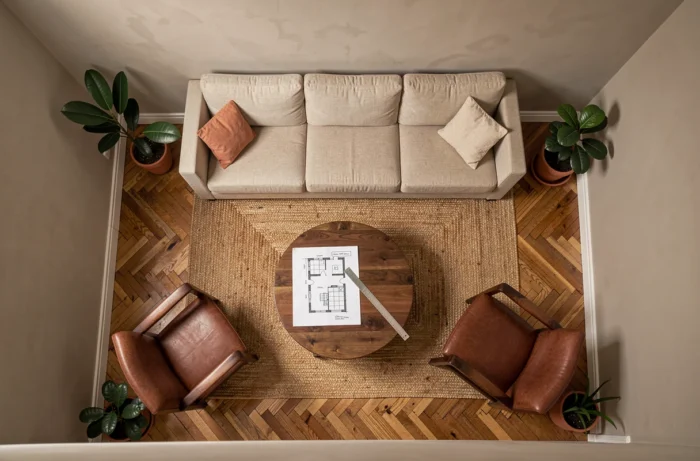
- Transfer these measurements to the floor with tape. Live with this fictitious rectangle for a day or two: walk past it, sit on a chair inside the perimeter, open nearby doors. This full-scale test reveals space conflicts that a plan does not show.
If you are hesitating between two sizes, favor the smaller one. A slightly compact sofa in an airy living room always gives a better visual result than an oversized model that takes up all the circulation space.
Sofa height and visual volume in the room
A rarely mentioned point: the height of the backrest alters the perception of the room as much as the width of the sofa. A high backrest (over 85 cm) provides good neck support, but it cuts the line of sight and visually weighs down a small living room.
A low backrest opens up the perspective and visually enlarges the room. This type of sofa is particularly suitable for living rooms that open onto the dining area, where the view should be able to cross the space without obstacles.
Also consider the seat height: it should remain close to that of the coffee table for a proportionate ensemble. A gap of more than a few centimeters between the two creates a visual imbalance that is perceived without knowing how to explain it.
The right sofa is not the one that fills the living room, but the one that allows the square meters around it to breathe. Take the measuring tape before the catalog, and always start with the path the sofa will need to take to get to your home.