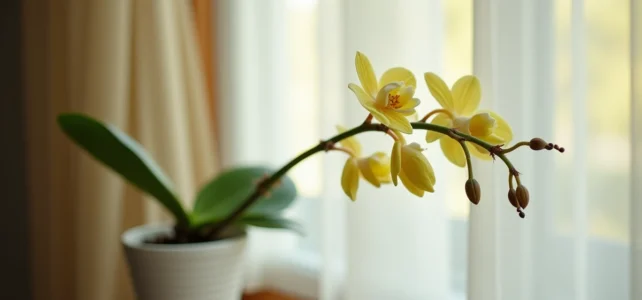
A floral spike of Phalaenopsis turning yellow after the last flowers have fallen is part of the normal senescence of floral tissue. The problem begins when this yellowing occurs during blooming, affects the collar, or is accompanied by soft and watery areas. Here, we distinguish the precise physiological mechanisms behind each type of stem yellowing, and the interventions that work.
Senescence of the floral spike in Phalaenopsis: normal yellow stem or warning signal
A spike that yellows from the tip towards the base after flowering follows a programmed process of nutrient redistribution towards the reserves of the pseudobulb and leaves. The plant reabsorbs nitrogen and phosphorus stored in the stem before drying it out. No treatment is necessary.
Cutting occurs only when the stem is completely dry and brittle. Cutting a still partially green spike interrupts this nutrient transfer and deprives the plant of resources it mobilizes for the next bloom. We recommend using a sterilized flame pruner, cutting flush with the foliage.
The warning signal is the sudden yellowing of a stem still in bloom. If the spike becomes soft, shows brownish or translucent areas, the problem lies at the root level or collar. In this case, immediate repotting and inspection of the roots are necessary.
Understanding why my orchid’s stem is yellowing helps to separate these two situations before mistakenly intervening on a plant at the end of its normal cycle.
Collar rot and excess water: yellowing starting from the base of the stem
When the stem yellows from its junction with the foliage and the tissues feel spongy to the touch, the cause is almost always excess water at the collar. Standing water between the leaves, combined with a constantly saturated bark substrate, creates an anaerobic environment favorable to Fusarium and Pythium.
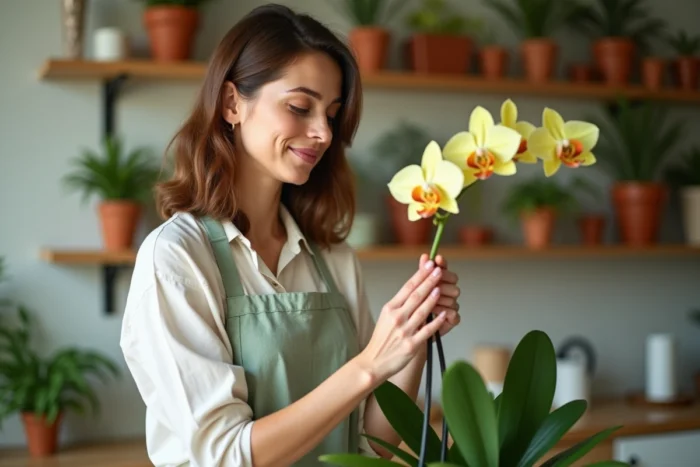
The transparent pot is a diagnostic tool before being an aesthetic choice. It allows for a visual check of the substrate and root condition without repotting. Green and firm roots indicate proper hydration. Brown, soft, or hollow roots signal established rot.
Immersion watering protocol
Immersion watering remains the most reliable method for potted Phalaenopsis. The principle: soak the pot in a basin of non-limestone water for about fifteen minutes, then let it drain completely. The operation is only repeated when the bark substrate is almost dry, which can be checked by the silvery-gray color of the aerial roots.
- Green roots after watering, gray-silver when the substrate dries: normal cycle, do not water until they turn gray again
- Brown or soft roots to the touch: suspend watering, repot, cut necrotic parts with a sterilized pruner, let the collar dry in the open air before repotting
- Water stagnating in the heart of the leaf rosette: systematically soak up after each watering, this is the primary cause of collar rot in Phalaenopsis
Never leave the pot soaking in a saucer of residual water. Epiphytic orchid roots do not tolerate permanent immersion, even partial.
Degraded substrate and nitrogen deficiency: gradual yellowing of the spike
A pine bark substrate decomposes over time. As it compacts, it retains more moisture, reduces root aeration, and alters the pH around the roots. We observe that the majority of spikes that yellow prematurely come from plants that have not been repotted for more than two years.
The degradation of the substrate causes a double problem. First, root asphyxiation limits mineral absorption. Then, the gradual acidification blocks iron and manganese, elements necessary for chlorophyll synthesis in the still green tissues of the spike.
Repotting and choice of substrate for epiphytic orchids
Repotting ideally occurs after flowering, when the plant enters the vegetative growth phase. A mixture of medium-sized pine bark, a small proportion of sphagnum, and perlite ensures the necessary drainage and moisture retention.
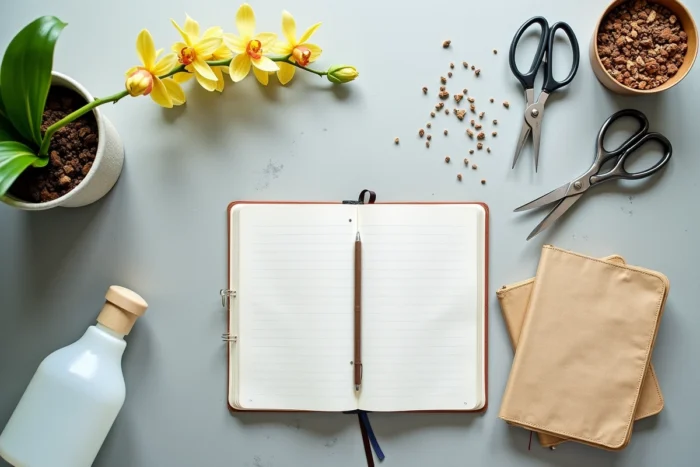
During repotting, all dead roots (brown, hollow, easily detaching from their velamen) are removed. Healthy aerial roots remain outside the pot; they participate in photosynthesis and the absorption of ambient moisture.
A special low-nitrogen orchid fertilizer, applied every other watering during active growth, prevents deficiencies without the risk of root burn. Excess fertilizer is as harmful as deficiency: black and dried roots are a sign of this.
Heat stress and direct light: burning of the floral spike
A stem that yellows on one side, the one exposed to the window, indicates sunburn. The tissues of the Phalaenopsis spike cannot withstand direct radiation, especially through glass that amplifies the thermal effect. Bright indirect light is the only suitable light regime for these orchids.
In summer, the temperature behind a south-facing window can far exceed the tolerance threshold of Phalaenopsis. The plant reacts by sacrificing its floral spike to protect its leaves and roots. The yellowing is then rapid and irreversible on the burned portions.
- Move the pot at least one meter away from any window exposed to direct sunlight between May and September
- Prefer an east or northeast exposure, with sheer curtains if the brightness remains strong
- Check that the aerial roots are not dried out and brittle, a sign of excessively dry ambient air often associated with overheating
The yellowing of an orchid stem does not always warrant intervention. After flowering, it is a nutrient recycling mechanism. However, any soft, brown, or translucent stem during blooming requires an examination of the roots and collar. The most effective response is often the simplest: adjust watering, check the substrate, control light exposure.