
La Provençale Bio displays a Cosmos Organic certification on almost all of its products, which imposes a precise specification regarding the proportion of natural and organic ingredients in each formula. Behind the green glass packaging and the “accessible organic” positioning, the actual composition of the products deserves careful reading, especially in light of evaluation tools like Yuka or analyses from Que Choisir.
Cosmos Organic Certification: What It Guarantees in Composition
The Cosmos Organic label requires that a minimal percentage of plant ingredients come from organic farming. It also prohibits silicones, parabens, mineral oils, and GMOs. For a brand like La Provençale Bio, this means that each formula undergoes an external audit before being brought to market.
This certification does not cover all aspects. It allows certain synthetic preservatives (such as sodium benzoate or potassium sorbate) as long as they appear on the positive list of the reference. Therefore, a Cosmos Organic certified product does not necessarily mean a 100% natural formula, and this distinction matters when looking for an opinion on the composition of La Provençale Bio based on objective criteria.
The specifications also set rules regarding the permitted processing methods and packaging. The certification pertains to the formula, not the efficacy of the product, which explains why two labeled products can yield very different results on the skin.
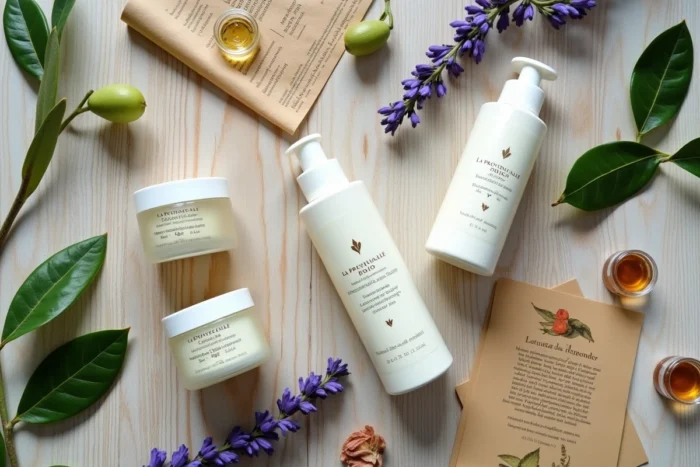
Recurring Ingredients in La Provençale Bio Formulas
By browsing the INCI lists of several references (face creams, serums, body milks), certain ingredients appear systematically. Organic olive oil serves as the brand’s signature active ingredient, listed as Olea Europaea Fruit Oil in most products.
Common Bases for Face Care Products
Day and night creams share a similar structure: an aqueous phase (aqua), plant emollients (olive oil, shea butter depending on the ranges), a compatible bio emulsifier, and texture agents like vegetable glycerin. The fragrance appears in most formulas, including those intended for sensitive skin.
The presence of fragrance, even of natural origin, is a point of caution for individuals prone to skin allergies. Cosmos Organic allows natural fragrances, but they contain declarable allergens (linalool, limonene, citronellol) that are indeed found in the INCI lists of La Provençale Bio.
The Preservatives Used
The formulas rely on preservatives compatible with the organic specifications:
- The sodium benzoate, a synthetic preservative authorized by Cosmos, commonly found in organic cosmetics for its stability in aqueous environments
- Potassium sorbate, often paired with sodium benzoate to broaden the antimicrobial spectrum
- Benzylic alcohol, which serves a dual role as a preservative and solvent, but is also among the regulated allergens
These preservatives do not pose toxicological issues at the concentrations used according to European regulatory assessments. However, their presence explains why some products do not receive the maximum rating on Yuka, as the application systematically penalizes synthetic preservatives in its rating algorithm.
Yuka Ratings and Que Choisir Analysis: Two Different Evaluation Frameworks
Yuka assigns a score out of 100 by combining the presence of ingredients deemed “risky” and the percentage of organic components. Most La Provençale Bio products receive scores in the upper part of the scale, with mentions of “Good” or “Excellent.” A few references score lower due to a fragrance or a specific preservative.
The Yuka algorithm measures neither the efficacy nor the actual tolerance of the product. It evaluates a theoretical risk based on toxicological studies, without considering the effective concentration of each ingredient in the final formula. A product rated 80/100 is not necessarily better for the skin than a product rated 65/100.
Que Choisir’s approach differs. The comparison “Toxic Substances in Cosmetics” lists products containing one or more undesirable ingredients (irritants, allergens, suspected endocrine disruptors). Some La Provençale Bio references appear in this database, not for serious substances, but for the presence of allergens related to natural fragrance.

Revision of the European Cosmetic Regulation: An Impact to Anticipate
The European Union is preparing a revision of regulation 1223/2009 governing cosmetic products. This update particularly targets substances suspected of being endocrine disruptors, certain preservatives, and UV filters, with new restrictions expected by 2027.
For La Provençale Bio, the stakes involve two families of ingredients. First, some preservatives currently authorized by Cosmos may see their regulatory status evolve. Second, the management of CMR (carcinogenic, mutagenic, toxic for reproduction) substance mixtures will be tightened, requiring brands to reformulate even products that are currently compliant.
A formula deemed “clean” by Yuka in 2026 could therefore come under regulatory pressure in the following months. The composition of an organic cosmetic is not fixed; it evolves with the legal framework.
Reading an INCI List: Useful Reflexes Beyond Yuka
Rather than relying on a single score, cross-referencing multiple sources of information remains the most reliable method for evaluating a composition:
- Check the position of the fragrance in the INCI list: the higher it is, the higher its concentration
- Identify the declared allergens at the end of the list (linalool, limonene, geraniol) and cross-reference them with known sensitivities
- Consult the Que Choisir comparison in addition to Yuka to spot any potentially undesirable ingredients
- Distinguish active ingredients (olive oil, vitamin C) from texture and preservative ingredients, which often make up the majority of the formula
La Provençale Bio offers relatively short formulas compared to conventional cosmetics, with a base of natural origin ingredients compliant with its label. Points of attention focus on the fragrance and its associated allergens, the only element that generates recurring reservations in independent evaluations. The rest of the composition reflects a large-scale organic positioning, honest about its promises, without reaching the minimalism of “zero compromise” cosmetics.