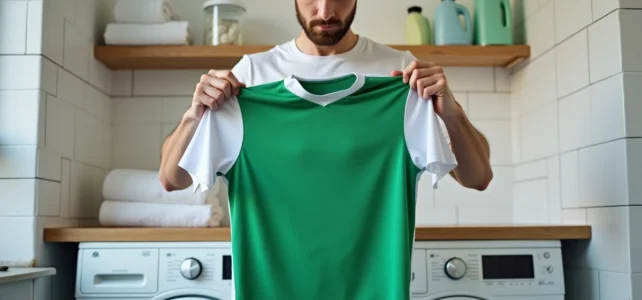
A football jersey that is too large floats on the chest, pulls on the shoulders, and ruins the silhouette. The classic reflex, putting it through a hot wash, may seem logical. The problem is that most modern jerseys are made from technical polyester, a fiber designed to withstand heat and maintain its dimensions. Shrinking a football jersey without damaging it requires understanding what actually shrinks and what is likely to degrade first.
Flocking and heat transfers: the real limit to know
Before discussing temperature or tumble drying, one point deserves your full attention. On a flocked jersey, the flocking gives way long before the fabric. The heat-activated adhesive that holds the names, numbers, and logos begins to soften and crack beyond 40 °C.
You can expose polyester to moderate heat without the fiber moving a millimeter, but the transfer will have already started to bubble or peel. This is a common trap: the fabric may seem intact, but the flocking is irreversibly damaged.
If your jersey has flocking or heat-activated patches, always turn it inside out before any thermal manipulation. This limits direct contact between the heat source and the printed surface. To delve deeper into the various approaches to shrink a football jersey, the choice of method directly depends on the presence or absence of these fragile elements.
Technical polyester and cotton-blend jersey: two opposite reactions to washing
A 100% polyester jersey (Dri-FIT from Nike, AEROREADY from Adidas) has been factory tested for its dimensional stability. A wash at 20-30 °C followed by air drying causes virtually no shrinkage, even after many cycles.
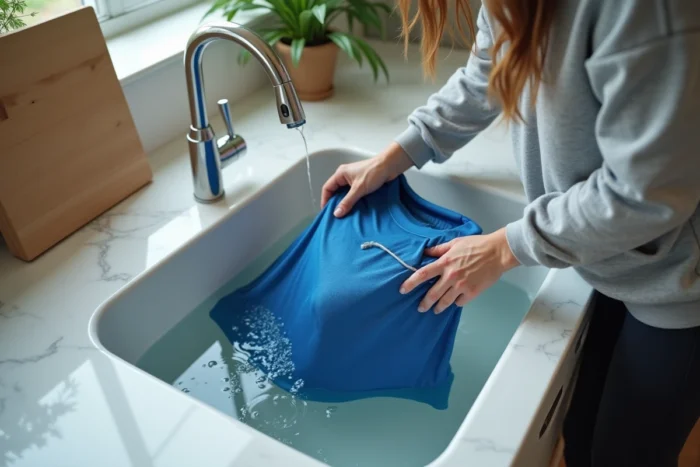
In contrast, a cotton-polyester blend jersey reacts very differently. The cotton fibers absorb water, swell, and then contract as they dry. A cotton-polyester jersey can lose between 3 and 8% of its dimensions after a poorly controlled first wash.
Before any attempt, check the composition label. It determines the strategy:
- 100% polyester: shrinkage from washing alone is almost negligible. You need to combine heat and mechanical pressure (tumble dryer) to achieve a slight effect, with a high risk for the finishes.
- Cotton-polyester blend: a wash at a higher temperature (not exceeding 40-50 °C) followed by a tumble dry on moderate heat may be enough to gain half a size.
- Majority cotton: shrinkage is easier to achieve, but the loss of shape can be uneven if the heat is not homogeneous.
Controlled soaking technique to shrink a polyester jersey
<p Soaking in hot water remains the most common method. It works, provided you do not pour boiling water directly onto the fabric. Boiling water distorts the fibers brutally and can cause uneven shrinkage, with wavy areas that are impossible to fix.
You may have noticed that a synthetic garment taken out of a bath that is too hot sometimes has a wrinkled appearance? This is exactly what you need to avoid.
Here is the method that offers the best compromise:
- Fill a basin with hot water (around 50-60 °C, or water in which you cannot keep your hand for more than a few seconds).
- Turn the jersey inside out, dip it, and let it soak for about twenty minutes. Do not stir or rub.
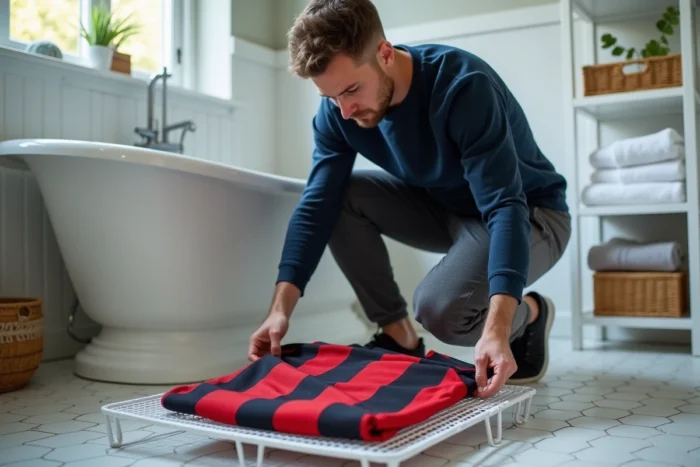
- Remove the jersey, gently squeeze it without twisting, then lay it flat on a clean towel to dry.
- If the result is insufficient after complete drying, a tumble dry on low temperature (delicate cycle) can enhance the effect. Limit this to about ten minutes to avoid damaging the flocking.
This gradual approach is preferable to a single violent thermal shock. A gradual shrinkage better preserves the overall shape of the jersey than a single attempt at extreme temperature.
Why the tumble dryer alone is not always enough
The tumble dryer works by combining heat and mechanical agitation in the drum. On technical polyester, heat alone produces little effect: it is the repeated movement that forces the fibers to tighten slightly. The problem is that this agitation also wears down the finishes, side seams, and decorative bands.
A delicate cycle limits the damage, but does not eliminate it. The tumble dryer remains the most risky tool for a flocked jersey.
Sewing alteration: the reliable solution when heat is not enough
If your jersey is made of technical polyester and exceeds your size by a good margin, heat will only produce a marginal result. In this case, sewing alteration remains the most reliable and predictable option.
A tailor can take in the side seams to adjust the jersey to the torso without touching the flocking or the front finishes. The cost remains modest compared to the price of an official jersey, and the result is permanent.
This option is particularly relevant for vintage or collectible jerseys, where the risk of damaging an old fabric with heat far outweighs the benefit of gaining half a centimeter.
Thermal shrinkage of a football jersey mainly works on blends containing cotton. For a 100% polyester jersey, the actual margin for shrinkage is low and the flocking pays the price first. Adapting the method to the fabric composition, proceeding in short steps, and considering sewing alteration when the size difference is too great: this is the combination that protects both the cut and the finishes of the jersey.