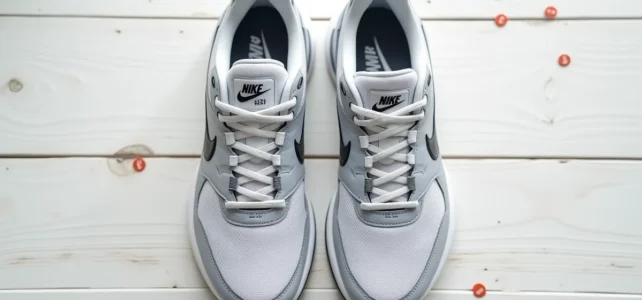
Distinguishing an authentic pair of Nike from a counterfeit relies less on intuition and more on a structured verification method. Fake models now replicate the brand’s visual codes with a precision that makes superficial examination insufficient. This article compares the most discriminating checkpoints and their respective reliability for recognizing genuine Nikes.
Comparative Reliability of Nike Authentication Methods
Not all verification techniques are equal. Some can rule out a blatant counterfeit in seconds, while others require meticulous examination but can detect the most carefully crafted copies.
| Verification Method | What It Detects | Main Limitation |
|---|---|---|
| QR code scan via the Nike or SNKRS app | Model, color, size match in the official database | A valid QR code can be copied onto a fake box |
| SKU code verification on the box and label | Consistency between product reference and advertised model | Fakes can display a real SKU without the pair matching |
| Typographic inspection of the inner label | Font, spacing, character alignment | Requires a reference photo for comparison |
| Examination of materials and finishes (stitching, sole, swoosh) | Manufacturing quality, stitch regularity, adhesion | High-end copies closely mimic texture |
| Cross-referencing multiple criteria simultaneously | Invisible inconsistencies with a single test | Requires time and a minimum of experience |
The table highlights a point that classic guides underestimate: no isolated method is sufficient to guarantee authenticity. An authentic SKU attached to a fake pair passes the code test but fails the physical inspection. Conversely, clean stitching proves nothing if the QR code points to a different model.
To follow a reliable Nike authentication procedure, at least four to five tests must be combined before concluding.
Nike Inner Label: The Most Discriminating Checkpoint
The size label sewn inside the shoe remains the hardest marker to reproduce accurately. Counterfeiters invest in outer materials but often neglect internal typography.
On an authentic pair, the font used for the country of manufacture, size, and barcode follows a regular and consistent spacing. The letters never touch, and the vertical alignment between the columns (US, UK, EUR, CM) remains perfect.
What a Detailed Comparison Reveals
- The font on fake models shows variations in thickness, particularly on the numbers “8” and “0,” which appear bolder or thinner than on the original.
- The spacing between the barcode and the text below often differs: too tight or too wide compared to Nike standards.
- The position of the label itself varies: on an authentic Dunk Low model, it is consistently located in the same relative position to the tongue seam.
The typography of the label betrays the majority of counterfeits, including those with a neat exterior appearance. Comparing with a high-resolution photo of an identical pair purchased from the Nike site or via SNKRS provides a reliable reference point.
QR Code and Nike App: Digital Verification and Its Blind Spots
The Nike and SNKRS apps allow you to scan the QR code or barcode present on the box and on the inner label. The scan checks if the reference exists in the official database and if it matches the displayed model, color, and size.
This method is among the most robust for confirming that a product code is real. However, a QR code alone is never proof of authenticity. Counterfeiters obtain valid codes and reproduce them on their boxes and labels.
Cross-Referencing the Scan with Physical Inspection
A positive scan means that the code exists at Nike. It does not guarantee that the pair in the box is the one that corresponds to this code. For digital verification to have real value, it must be accompanied by a physical check.
The most reliable protocol is to verify that the SKU on the inner label, the one printed on the box, and the one returned by the scan all correspond to the same model, size, and colorway. Any inconsistency between these three sources signals a probable counterfeit.
Swoosh, Stitching, and Sole: What Physical Examination Can Still Reveal
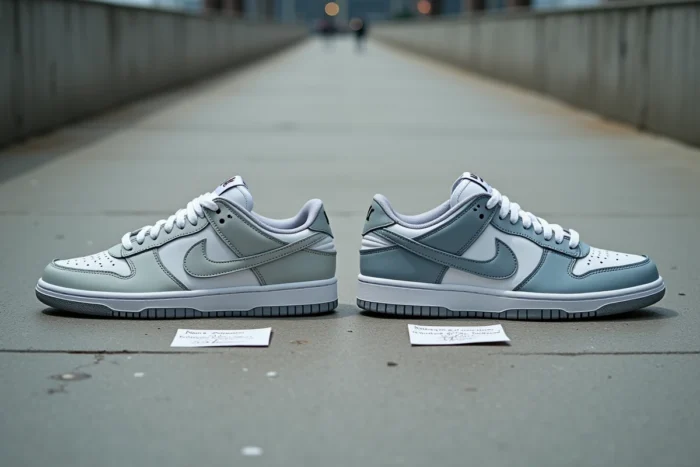
Visual inspection points remain useful, provided you know where to look. The Swoosh logo on counterfeits often shows a slightly different curvature, a modified angle of inclination, or uneven embroidery thickness. These discrepancies are subtle on recent copies but become visible when mentally overlaying the left and right Swoosh: on a genuine Nike, both Swooshes are symmetrical to the millimeter.
The stitching is another indicator. On an authentic model, the stitches are regular, and the thread does not protrude. Counterfeits sometimes show loose threads at the junctions between the toe box and the side panels.
Finally, the sole deserves tactile examination. The rubber used by Nike retains some flexibility, while low-quality copies produce a stiffer sole, accompanied by a strong chemical odor upon unboxing.
None of these clues taken alone can settle the question. A perfect Swoosh does not compensate for an inconsistent SKU, and clean stitching does not validate a label whose typography differs from the standard. The only approach that truly reduces risk is to systematically cross-check digital and physical verifications, treating each test as an additional filter rather than a definitive answer.