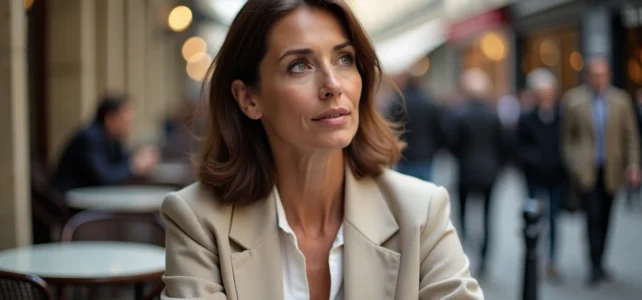
Élodie Huchard is one of those political journalists whose face is familiar, but whose personal life remains a blind spot for the public. Present on continuous news channels, she comments on French political news with a regularity that ensures her strong visibility. However, no interview or magazine profile has lifted the veil on her daily life off-camera.
Élodie Huchard’s Private Life: What the Lack of Information Tells Us
When searching for details about Élodie Huchard’s private life, the conclusion is quick: there is nothing confirmed. No publicly identified partner, no children mentioned in an official statement. This void is not an oversight. It is the result of a choice maintained over several years.
By comparison, most figures in television journalism eventually let personal elements slip out, whether intentionally or not. A vacation photo shared by a gossip magazine, a mention in a promotional interview, a snapshot taken at a public event. With Élodie Huchard, none of these breaches have been documented to date.
An article dedicated to Élodie Huchard’s family and children highlights this strict separation between professional and intimate spheres, without managing to contradict it with verifiable facts.
This opacity logically fuels online speculation. But speculating is not documenting. The absence of confirmation is as significant as the absence of denial: it proves nothing one way or the other.
Social Media Fame and Protection of Family Life
Have you ever noticed that a simple clip from a show can circulate for days on social media? For a political journalist like Élodie Huchard, each appearance on air potentially generates derivative content: screenshots, short edits, reposts on third-party accounts.
This phenomenon changes the very nature of media exposure. In the past, a journalist’s fame was confined to the broadcast time. Today, a few minutes of editorial can be cut, commented on, and redistributed on platforms where the journalist has no editorial control.
What Short Content Changes in Practice
Viral clips create permanent and uncontrollable visibility. A clip shared on a social network reaches a much wider audience than that of the original channel. This audience may not necessarily know the context of the intervention, but they recognize the face.
For someone who wants to protect their family life, this expanded visibility poses a concrete problem:
- A face recognized in the street increases the risk of candid photos, especially in everyday places (school pickups, shops, public transport)
- Fan or media monitoring accounts systematically compile public appearances, creating a timeline that anyone can exploit
- Recommendation algorithms push controversial or personal content, prompting some internet users to actively seek private information
Élodie Huchard seems to have integrated this reality in advance. Not publishing anything personal deprives algorithms of raw material. Without shared family photos, without mention of a vacation spot, there is nothing to repost or comment on.
Discretion of Political Journalists: A Career Strategy
Why can this choice of discretion be seen as a professional strategy? Because the job of a political journalist relies on perceived credibility. A commentator whose personal life becomes a topic of discussion loses part of their authority on the subjects they cover.
The mechanism is quite simple to understand. As soon as an intimate detail circulates, a fraction of the public begins to interpret the positions taken through this personal prism. Protecting one’s private life is also about protecting one’s public voice.
What This Implies in Daily Life
Maintaining this separation requires constant discipline. It is not limited to refusing celebrity interviews. It also involves controlling every digital interaction:
- No public personal accounts on social media, or a locked account with no identifiable content
- No participation in social events where presence is photographed and shared
- Vigilance regarding mentions by colleagues or acquaintances that could inadvertently reveal information
This approach is not unique to Élodie Huchard, but it is applied with a level of rigor that is uncommon in the French audiovisual landscape. Most journalists eventually give in on a detail, even if it’s just by answering a trivial question during a broadcast.

Élodie Huchard and the Right to Privacy of Public Figures
The French legal framework protects the privacy of every person, including those engaged in public activities. The civil code establishes the principle of respect for intimacy, and case law has regularly sanctioned publications revealing personal elements without consent.
For a journalist like Élodie Huchard, this framework offers real but incomplete protection. The law protects after publication, not before viral dissemination. A photo taken in a public place and shared in seconds on a social network can circulate widely before any legal action is taken.
It is precisely this limit that makes the preventive strategy more effective than legal response. By not providing any exploitable personal content, Élodie Huchard reduces the risk at the source rather than having to manage it afterward.
The silence she maintains about her family is therefore not just a character trait. It is a fitting response to a media environment where the boundary between public and private life blurs a little more each year, driven by tools that neither the law nor ethical charters have yet fully caught up with.