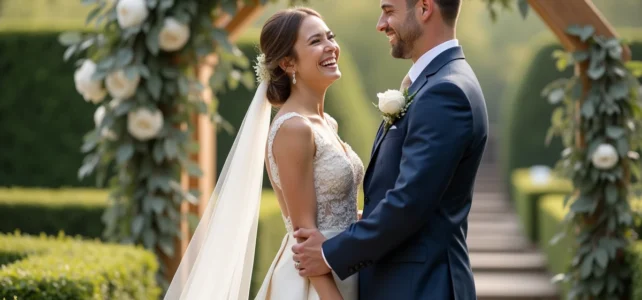
Organizing a wedding in 2026 means dealing with changed expectations. Couples want less rigid protocol and more moments that reflect their personalities. This translates into concrete choices, from the format of the ceremony to budget management, where personalization takes precedence over tradition.
Artificial Intelligence and Wedding Planning: A Common Tool
Have you ever spent an hour writing a best man’s speech without finding the right tone? According to data presented at the Wedding Fair in Paris and reported by Mariages.net, more than a third of couples use AI to write their speeches or manage their budget. This practice is rapidly growing, especially among couples under 35.
AI does not replace the sincerity of a personal text. It serves as a starting point. A couple can generate a first version of their vows and then refine it by adding real anecdotes. The time savings are significant for repetitive tasks: simulating a budget, comparing caterer quotes, creating a wedding website with coherent content.
“Digital-first” planning tools are also becoming widespread. QR codes on invitations to confirm attendance, interactive forms to collect dietary restrictions, shared spreadsheets to coordinate vendors. Publishing ideas and following trends on Actu Mariage allows couples to identify these solutions before committing to a wedding planner.
The risk is producing something generic. An AI-generated text is recognizable if no one personalizes it. The tool works better when it structures rather than invents.
Minimalist Weddings: Reducing the Guest List for Greater Intensity
The clearest trend in recent seasons is the intentional reduction of the guest list. Fewer people at the table, but deeper exchanges with each attendee.
Why this choice? Because a small wedding allows for a more substantial budget per guest. Instead of serving a standard menu to 150 guests, some couples prefer to offer a gastronomic experience to 40 or 50 carefully selected close friends.
- A more intimate reception venue (private estate, restaurant, farmhouse) often costs less than a large hall and provides a warmer setting.
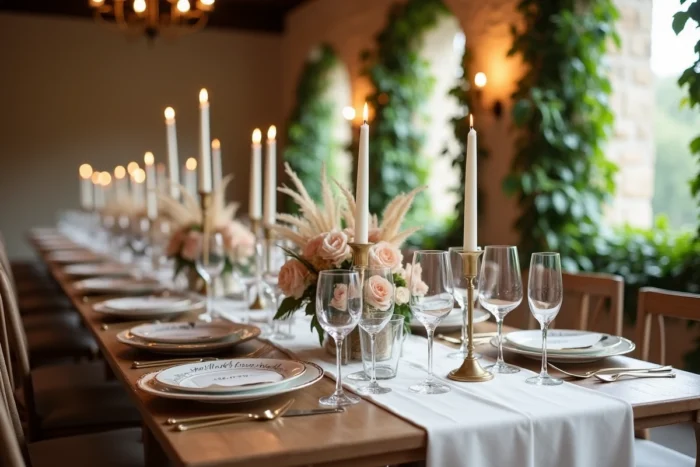
- Decoration gains coherence when it dresses a smaller space: every detail stands out, from centerpieces to candles.
- Entertainment changes in nature. Instead of a DJ facing 200 people, an acoustic musician or a participatory workshop creates real connections among guests.
Fewer guests does not mean less of a celebration. It means a different format, where the quality of each moment takes precedence over the number of tables set.
Personalized Secular Ceremony: Writing Your Own Rules
The secular ceremony has become the preferred format for couples who want to speak in their own words. No imposed text, no liturgical framework, no location constraints. It can take place in a garden, on a beach, in a castle courtyard, or under a simple floral arch.
Building a Narrative Flow
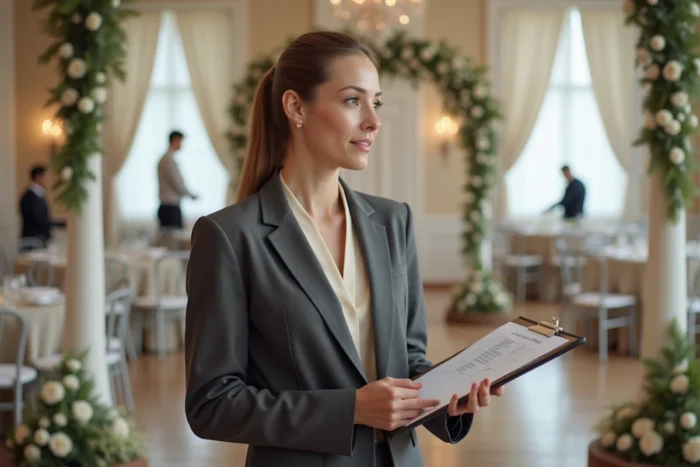
The trap would be to replicate a model seen on social media without adapting it. A successful secular ceremony starts with the couple, not a template. Practically, this means choosing an officiant (close friend, family member, professional celebrant) who can embody the right tone.
A good officiant asks the couple questions several weeks before the big day. They collect anecdotes, identify foundational moments of the relationship, and weave a narrative thread that gives meaning to the ceremony.
Some elements that work well:
- Readings chosen by loved ones, provided they are rehearsed aloud before the big day to avoid awkward pauses.
- A symbolic ritual (sand, wine, candle) that physically involves the couple rather than a simple passive speech.
- An entrance and exit playlist that reflects the couple, not a generic hit chosen at the last minute.
Be Mindful of Timing
A secular ceremony rarely exceeds 30 to 40 minutes if well-structured. Beyond that, guest attention wanes, especially outdoors in the heat. It’s better to cut a lengthy text than to lose the emotion of the moment.
Sustainable Wedding Decoration: Trend or Fundamental Shift?
Dried flowers, vintage tableware, and reusable elements are no longer a niche. They address both budgetary and ecological concerns.
A centerpiece made of imported fresh flowers is expensive and ends up in the trash the next day. An arrangement of dried flowers, candles, and thrifted ceramics can be prepared months in advance, transported easily, and preserved after the celebration.
Sustainable decoration requires more anticipation but less budget on the big day. Some couples organize preparation days with their loved ones to assemble the elements. This shared time becomes a memory in itself.
The same reasoning applies to stationery. Digital invitations with QR codes are gradually replacing printed cards. The wedding website centralizes practical information (location, accommodation, gift list) and avoids back-and-forth messaging.
The choice between tradition and modernity does not need to be binary. A couple can send a paper invitation to grandparents and a digital link to the rest of the guest list. Organizing a wedding lies in these concrete trade-offs, not in the rigid application of a single trend.