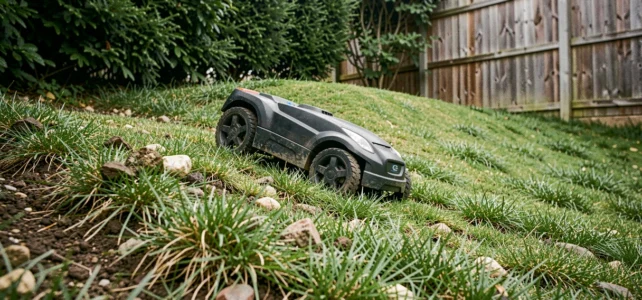
A garden with a marked slope or uneven ground completely changes the game for a robotic lawn mower. The technical specifications display slope capabilities measured in a laboratory, on regular and dry surfaces, which explains the frequent discrepancy with actual behavior on the ground.
Before comparing brands or prices, it is essential to understand what distinguishes a robot capable of climbing from one that will slip at the first wet slope. Three technical parameters make the difference: traction, guidance behavior in cluttered environments, and the mechanical design of the chassis.
Four-wheel drive and traction: the primary criterion above all else
On sloped terrain, navigation technology (GPS, RTK, LiDAR) is useless if the robot does not have the necessary traction to climb. It is the mechanics that decide, not the electronics.
Beyond about 30% of actual slope, four-wheel drive becomes necessary. A two-wheel drive model may seem to climb during a demonstration on dry ground, but it will struggle on wet grass or after rain. The difference between an AWD robot and a conventional model becomes evident in these degraded conditions.
Why this threshold of 30%? Because it is the point where the weight of the robot, the resistance of the grass, and gravity create a precarious balance. A slightly greasy surface is enough for two-wheel drive to no longer suffice. Choosing the best robotic mower for steep slopes therefore starts with a simple check: how many wheels are actually driven, and what type of treads are on the tires.
Wide, aggressive treaded wheels provide significantly better grip than smooth wheels. Some manufacturers offer optional all-terrain wheel kits, but a robot designed from the outset for slopes integrates this traction into its architecture, not as an accessory.
RTK signal and uneven terrain: when satellite positioning falters
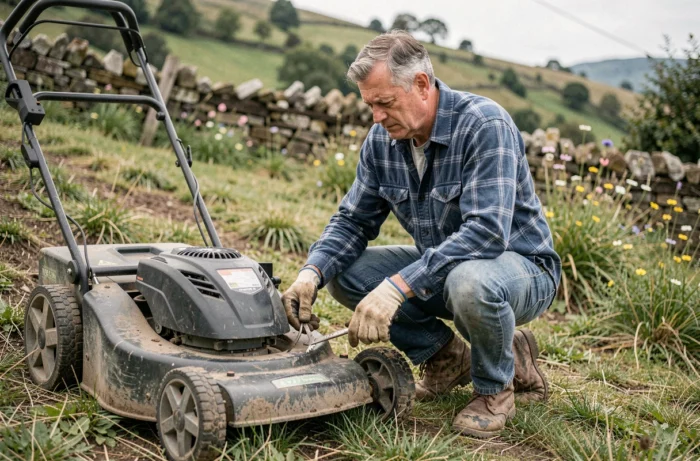
RTK guidance (centimeter-level satellite positioning) is touted as the best navigation technology for robotic mowers. On flat and open terrain, this is true. In a sloped garden with mature trees, nearby buildings, or steep banks, the reality is different.
The RTK needs a clear view of the sky to function correctly. The robot’s antenna and the base station must simultaneously capture satellite signals. As soon as vertical obstacles block part of the sky, the signal deteriorates.
Feedback from landscapers and individuals in 2026 reports a recurring issue: in sloped gardens bordered by trees or nestled against a facade, the degraded RTK signal causes erratic trajectories, uncut areas, and unexpected stops. Even high-end models are affected.
Do you have tall trees around your sloped lawn? Opt for a robot that combines RTK and sensor-based navigation (camera, LiDAR, or inertial sensors). This redundancy allows the robot to continue mowing even when the satellite signal weakens. A robot that relies solely on RTK will stop or drift in these shaded areas.
Articulated chassis and low center of gravity: what prevents tipping on slopes
The front slope (up and down) is not the only challenge. The side slope, or lateral incline, is often more dangerous. A robot traversing a slope diagonally experiences a force that tends to tip it over or slide laterally.
Two mechanical features reduce this risk:
- A center of gravity positioned as low as possible, thanks to a battery integrated into the chassis floor rather than the upper part. This increases stability without adding weight.
- An articulated chassis or independent suspension wheels, which allow all four wheels to remain in contact with the ground even on bumpy terrain. Without this articulation, a wheel lifts in a dip, and the robot loses traction.
- Inclination sensors that detect a critical angle and trigger a safety stop before any risk of tipping occurs. This device is mandatory on models compliant with European safety standards.
Uneven terrain often combines slope, exposed roots, small dips, and bare soil areas. A rigid chassis does not handle these variations well. Before purchasing, check if the robot has active suspension or at least sufficient travel to absorb irregularities.
Manufacturer’s advertised slope: how to read the figure without error
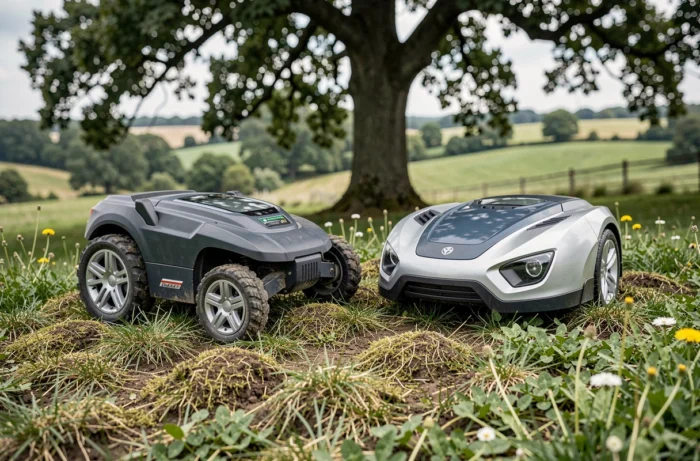
Manufacturers display a maximum slope in percentage. This figure is measured under laboratory conditions, on a regular and dry surface. The actual slope that your robot can handle is always lower than that stated in the technical specifications.
Why this discrepancy? Because your garden is not a smooth ramp. Wet grass reduces grip. Soft or clayey soil gives way under the wheels. A break in slope (a sudden transition from flat to uphill) creates a blockage point that the overall figure does not reflect.
In practice, apply a safety margin: if your steepest slope measures 35%, aim for a robot rated for at least 45 to 50%. This margin covers terrain variations, tread wear, and unfavorable weather conditions.
To measure your slope, a smartphone inclinometer app placed on a board on the ground provides a sufficiently reliable value. Measure the steepest section, not the average of the garden. It is this precise point that will determine whether the robot can pass or not.
What to remember before purchasing
A robotic mower for steep slopes should first be chosen for its traction (AWD with treads), then for its ability to navigate despite a degraded satellite signal, and finally for the design of its chassis. A trial on your own terrain remains the best indicator. If your dealer does not offer an on-site test, it is a warning sign regarding the confidence they have in their product.