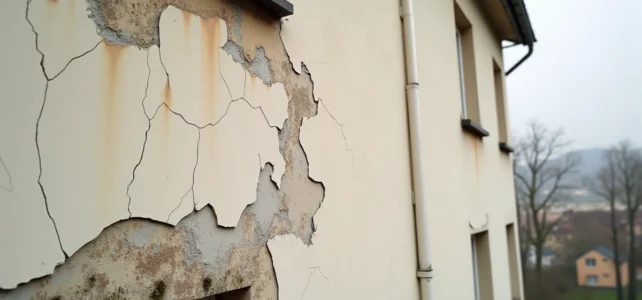
After several months of rain, frost, and successive thaws, a facade may show signs of damage that go beyond simple dirt. The distinction between a superficial stain and a structural damage relies on specific indicators that can be observed without special equipment. Identifying these indicators at the end of winter allows for intervention before water penetrates deeper into the wall.
Persistent stains after rain: the temporal criterion that few homeowners use
Most facades exhibit dark areas during a rainy episode. This normal phenomenon disappears within a few hours once dry weather returns. The warning signal does not come from the appearance of these stains, but from their duration.
Stains that remain visible several days after dry weather returns indicate that water is stagnating inside the wall. The coating no longer serves its barrier function, and moisture is not evaporating properly to the outside. We then speak of a wall that “no longer breathes.”
To assess the situation, simply photograph the facade right after a downpour, then take the same picture two or three days later in dry weather. If the halos have not moved, or if they have spread, it means that an active infiltration is progressing in the masonry. Calling on a facade craftsman for repairs after winter then becomes relevant for a precise diagnosis.
This temporal criterion is more reliable than a simple one-time observation because it distinguishes surface moisture (benign) from deep saturation (which degrades materials).
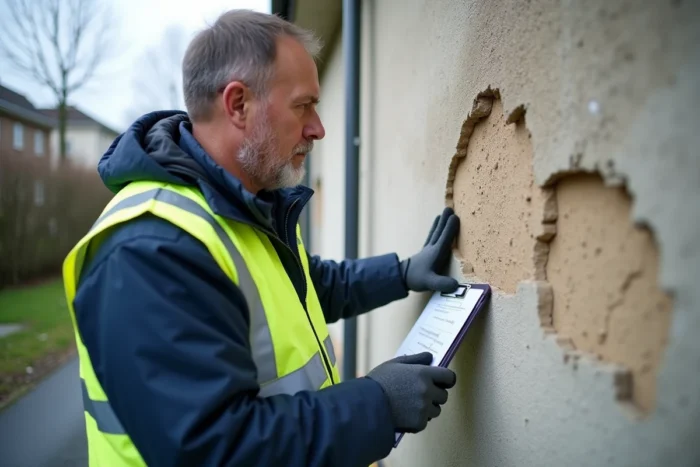
Facade cracks after winter: distinguishing superficial from structural
Repeated freeze-thaw cycles during winter exert mechanical pressure on coatings and masonry. Water infiltrates existing porosity or microcracks, freezes, expands, and then thaws. Each cycle widens the opening a little more.
Not all cracks warrant urgent repair. The distinction relies on three concrete criteria:
- Orientation and shape: a horizontal crack under a window sill or along a lintel often signals a localized joint or sealing issue. A stair-step crack, which follows the joints of the masonry, may reveal ground movement or differential settling.
- Width: microcracks (barely visible to the naked eye) are part of the normal aging of the coating. An opening into which the tip of a knife can be slipped requires further inspection.
- Evolution between autumn and spring: if a crack noted before winter has visibly widened by spring, the freeze-thaw cycle has worsened it, and repair is necessary before the next winter.
Photographing the cracks with a reference point (a piece of tape stuck across, for example) allows for measuring their evolution without specialized equipment.
Blistering or hollow-sounding coating: a sign of detachment in progress
A facade coating that has absorbed too much water during winter may detach from its substrate without being immediately visible. The indicators are of two types.
The first is visual: blisters, bulges, or areas where the paint is peeling in patches. These defects often appear on the lower parts of the facade, where rising damp adds to the rainwater.
The second is auditory. Tapping the facade with the back of the hand or a small mallet, a healthy coating produces a full sound. A coating detached from its substrate sounds hollow, indicating that adhesion has been broken. This area will eventually fall off, sometimes in patches several dozen centimeters wide.
The lower parts deserve special attention. Groundwater rises by capillarity in the walls, and this rising moisture creates a degraded band that can reach a variable height depending on the nature of the soil and the absence or deterioration of a capillary break.
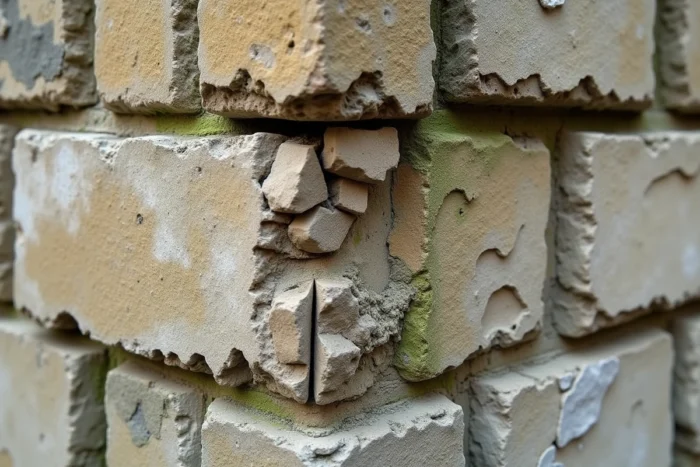
Window joints and thresholds: the weak points revealed by winter
The junctions between the facade and the joinery (windows, doors, roller shutter boxes) are the first areas where sealing fails. The joint sealant ages, shrinks, and eventually cracks or detaches from the substrate.
After a rainy winter, two simple checks are sufficient:
- Run your finger along the joint between the window frame and the coating. A joint that crumbles or detaches in pieces no longer protects against infiltrations.
- Observe the window sills (the lower ledges). A sill without sufficient slope or whose drip edge is blocked allows water to run against the wall instead of directing it outward. Vertical streaks under the sills confirm this defect.
These repairs (joint resealing, cleaning the drip edge, applying suitable sealant) are localized and inexpensive when addressed early. If postponed, they become the entry point for infiltrations that degrade insulation and interior finishes.
Mosses, lichens, and efflorescences: what they reveal about the state of the wall
Vegetation on north-facing facades or shaded areas
The presence of mosses or lichens after winter is not a damage in itself. It indicates a surface that retains moisture longer than normal. A healthy wall dries quickly and does not provide a favorable environment for these organisms.
When vegetation establishes itself in areas that were clean the previous year, it means that the surface protection (water-repellent or paint) has lost its effectiveness. The treatment combines appropriate cleaning and the reapplication of a water-repellent product to restore waterproofing.
White efflorescences
The white, powdery deposits that appear on the facade in spring are mineral salts transported by water through the wall. Their presence confirms that water circulates in the masonry and evaporates at the surface, leaving the salts behind. This mechanism, if repeated, weakens the coating and the mortar of the joints.
A cleaning with clear water is sufficient to remove visible efflorescences, but it does not address the cause. The source of the moisture (infiltration from above, rising damp, joint defect) must be identified and corrected to prevent the phenomenon from recurring in each wet season.
Inspecting a facade after winter takes about twenty minutes for a single-family home. The four areas to check as a priority are the lower parts, the perimeters of joinery, existing cracks, and north-exposed surfaces. A defect identified in March and treated in spring always costs less than a repair initiated after a second winter of degradation.