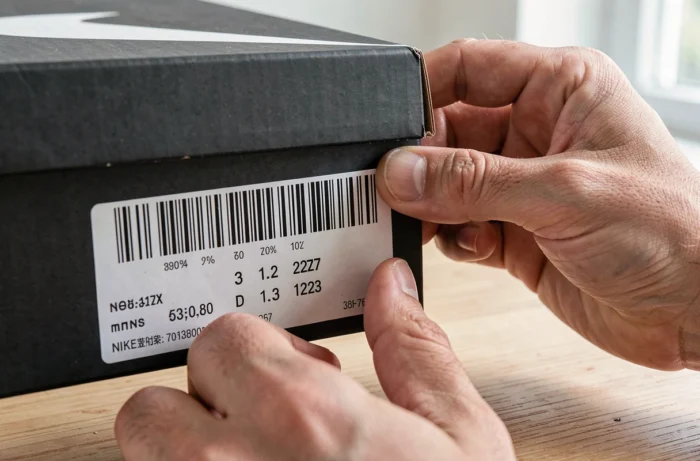
You have just found a pair of Nike shoes at an attractive price on a marketplace. Before finalizing the payment, two elements deserve your full attention: the barcode and the inner label. These details contain the most reliable information to distinguish an authentic pair from a counterfeit. However, you need to know how to read them correctly.
Nike QR Code: Why a Successful Scan Proves Nothing
Most guides recommend scanning the QR code attached to the box or label. The reasoning seems logical: if the code works, the pair is real. In practice, this reasoning is outdated.
Counterfeiters obtain the data from a legitimate pair (URL, product identifiers) and duplicate them on hundreds of copies. A functional QR code no longer guarantees the authenticity of a Nike sneaker.
What remains useful is the destination of the link. On recent models, an authentic QR code leads to a Nike page consistent with the exact model and colorway of the pair. A counterfeit often points to an inactive URL, a generic page, or an unrelated third-party site. Before checking the barcode and the Nike label, keep this reflex: never rely solely on the fact that the scan succeeds; examine the landing page.
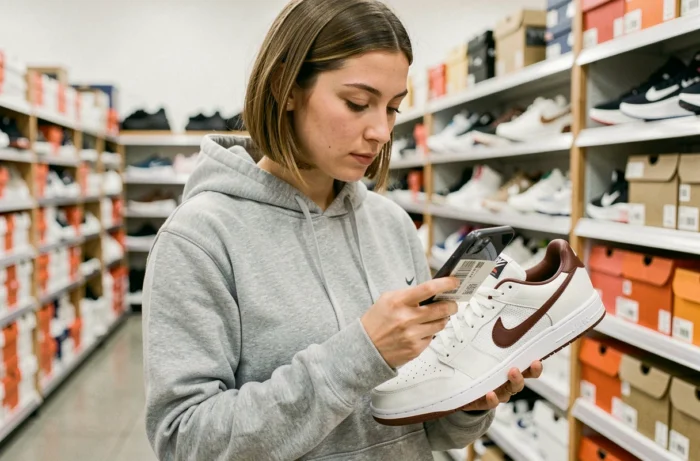
GS1 Registry and UPC Code: Verify that the Barcode Belongs to Nike
The barcode printed under the box or on the inner label contains a UPC number (in the United States) or EAN (in Europe). This number is not assigned randomly. It comes from a global organization called GS1, which registers the prefixes of each company.
Nike, Inc. has a registered GS1 prefix. This means you can enter the UPC/EAN code into a tool like GEPIR or Verified by GS1 to verify two things:
- The prefix corresponds to Nike and not to an unknown manufacturer or a company unrelated to the sports industry.
- The product associated with the code is consistent with the advertised model (for example, a Dunk Low and not a textile item).
- The code actually exists in the GS1 database and does not return an error or an empty result.
This verification takes a few seconds and serves as a filter that few buyers use. If the UPC code returns no results or points to another brand, the pair is suspicious, regardless of its visual appearance.
Decoding the Nike Inner Label Line by Line
The label sewn inside the shoe (often under the tongue or on the side of the heel) contains several lines of information. Each has a specific role.
Model Number and Color Code
The most useful line is the one that displays the style code, a format like “XX0000-000”. This code identifies the exact model and colorway. Type it into a search engine: it should match the model you have in front of you. An untraceable style code online is a major red flag.
On counterfeits, this number is sometimes invented or copied from another colorway. Comparing the code with search results takes a few seconds and already eliminates a good portion of crude copies.
Size, Country of Manufacture, and Date
The label displays the size in several systems (US, UK, EUR, cm). On an authentic pair, all size conversions are consistent with each other. A Dunk Low in EUR 42 corresponds to a US 8.5 and a UK 7.5. If any of the values do not match Nike’s conversion tables, it is an indication of a counterfeit.
The manufacturing date follows a specific format with letters for the season (SP for spring, SU for summer, FA for fall) followed by numbers for the year. Check that this date is compatible with the model’s release period. A colorway released in 2024 cannot have been manufactured in 2019.
Print Quality of the Label
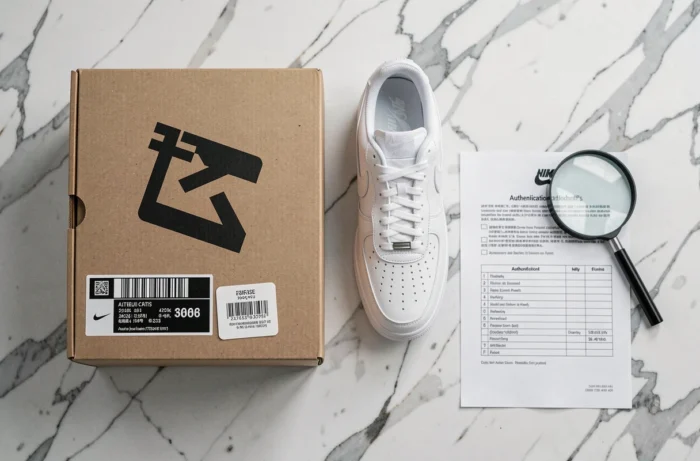
Beyond the content, the physical appearance matters. On an original pair, the letters are sharp, the lines well-aligned, and the ink does not smudge. Counterfeits often have slightly blurry characters, irregular spacing, or a font that subtly differs from the one used by Nike.
Have you ever compared two labels side by side? The difference in sharpness is striking when you know what to look for.
Cross-Referencing Data Between Box, Label, and Shoe
The most reliable verification does not rely on a single checkpoint but on their overall consistency. Here are the elements to systematically compare:
- The style code on the inner label must be identical to the one printed on the box label.
- The UPC/EAN code under the barcode on the box must correspond to the same model and colorway as indicated on the shoe label.
- The size displayed on the box, on the inner label, and on the insole must be the same across all systems (US, UK, EUR, cm).
- Any discrepancy between these three supports suggests a counterfeit, even if each element taken in isolation seems correct.
Counterfeiters are getting better at perfecting each detail taken separately. However, maintaining perfect consistency between the box, label, and shoe remains their weak point. This is precisely where cross-referencing data makes a difference.
Before any purchase on the secondary market, take thirty seconds for these cross-checks. A serious seller will always agree to provide clear photos of the inner label and the barcode of the box. A refusal or blurry photos often say more than any scan.