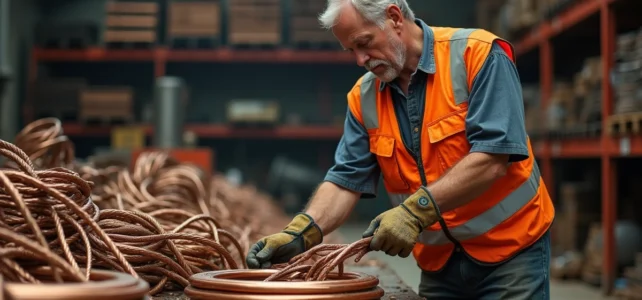
The price of copper at Derichebourg does not appear on any webpage of the group. No pricing grid, no indicative range, no buyback history: the Derichebourg Environment site presents its collection and recycling activities but systematically directs inquiries about pricing to its local agencies. This opacity complicates matters for individuals and craftsmen looking to compare before making a trip.
This article measures the gap between the prices charged by other recyclers (published online) and the pricing logic of Derichebourg, in order to establish concrete benchmarks before a first contact.
Why Derichebourg does not publish any copper buyback prices
The Derichebourg group is publicly traded. Its stock price and financial results are accessible, but no metal buyback prices are publicly displayed, neither for individuals nor for professionals. This absence is not an oversight: it reflects a structural operation.
The price of copper at Derichebourg is set locally, site by site. It depends on the volume brought in, the quality of the batch, and the global price of the day. Two agencies located in different regions may offer distinct prices for the same type of copper on the same day.
To find out the price of copper at Derichebourg today, the only reliable method remains direct contact: phone call, email, or visit to the agency. There is no simulator or updated grid available online.
This opacity is not unique to Derichebourg. Most major recycling operators in France operate in the same way, unlike some independent scrap dealers who display their prices on their websites.
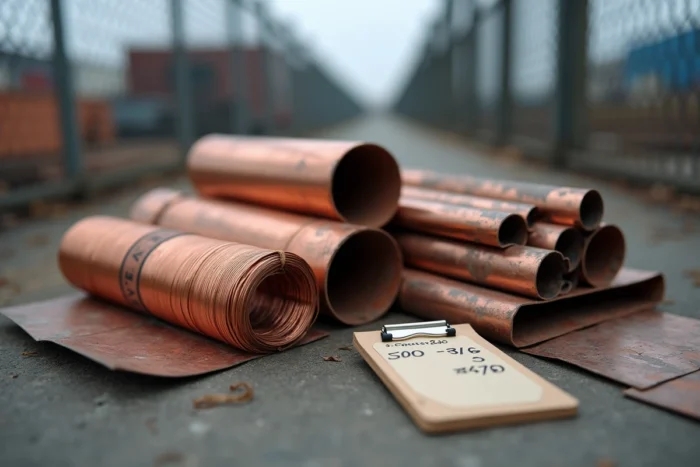
Comparative price grid for copper at recyclers who publish their prices
To situate what Derichebourg might offer, here are the prices displayed by independent recyclers who make their grids public. These prices vary each week based on the rates at the London Metal Exchange (LME).
| Type of copper | Indicative price per kilo | Main conditions |
|---|---|---|
| Red bare rigid copper (Millberry) | €9.60 to €9.90/kg | Rigid, shiny, without oxidation or varnish |
| Non-red bare rigid copper | €9.00/kg | Rigid, without varnish, not tinned |
| Soft bare copper | €9.00/kg | Without winding, without varnish |
| Mixed copper (pipes, objects) | €8.80/kg | Without fittings, without metal collars |
| Tinned heating body | €6.70/kg | Drained of its water |
| Electrical copper cable | €2.90/kg | Without plug, without fiber optic |
| Computer copper cable | €2.40/kg | Without plug, without lead |
The gap between Millberry copper and an unstripped electrical cable reaches a factor of three to four. The quality of sorting determines the price much more than the choice of recycler.
Price gap between sorted copper and raw copper: what sorting changes concretely
An individual bringing in a batch of electrical cables with plugs, sheaths, and mixed fiber optics will be offered the lowest rate, around €2 to €3/kg. The same weight of copper, once stripped and sorted by quality, can reach three times that amount.
This mechanism applies at Derichebourg as well as with any recycler. Here are the factors that affect the buyback price:
- The purity of the copper: a rigid red wire without oxidation is worth the maximum price, while tinned or painted copper suffers a significant discount
- The separation of materials: any residue of plastic, iron, lead, or glass lowers the classification of the batch and thus the applied rate
- The volume brought in: recyclers, including Derichebourg, often adjust their prices upwards for large volume contributions (several hundred kilos)
- The daily rate at the LME: the global price of copper fluctuates daily, and buyback grids follow these variations with a delay of a few days
Stripping your cables and separating qualities before going is the most direct lever to improve the price obtained, regardless of the chosen recycler.
A common trap with mixed copper
Plumbing pipes with brass fittings, valves, or iron collars are systematically classified as mixed copper, or even refused if sorting is not done. Some independent recyclers clearly indicate this on their grids: “if it is not removed, we do not buy.”
At Derichebourg, the exact conditions vary from site to site, but the logic remains the same. A batch refused for poor sorting will not be bought back at a reduced price; it will be refused.
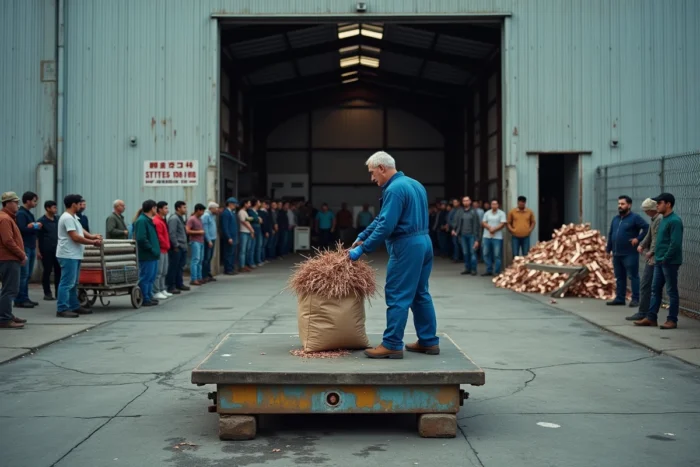
How to obtain the real price at Derichebourg before you go
Calling the nearest Derichebourg agency remains the most effective approach. During this call, three pieces of information allow for an accurate response:
- The type of copper (stripped, cable, pipe, heating body) and its condition (oxidized, tinned, painted)
- The approximate weight of the batch, even roughly estimated: a contribution of a few kilos will not be treated the same as a contribution of several hundred
- The presence or absence of mixed materials (plastic, iron, lead) that would downgrade the batch to a lower category
Derichebourg has sites spread across the entire French territory. The Derichebourg Environment site allows you to locate the nearest agency without providing any pricing.
Compare with at least two other local recyclers
Independent scrap dealers who publish their prices online provide a useful reference point. Noting the prices displayed by two or three recyclers in your geographical area before calling Derichebourg allows for negotiation with a concrete benchmark.
The price of copper per kilo varies from one to four depending on the quality of the batch, and the differences between recyclers for the same quality rarely exceed a few tens of cents. The upstream sorting weighs more on the final amount than the choice between Derichebourg and a local competitor.