
The choice of a blade is not just a linear match between hedge height and blade length. We regularly observe in the field that engine power, type of vegetation, and trimming frequency weigh as much, if not more, than the cutting length itself. Understanding these interactions helps avoid investing in oversized equipment or, worse, undersized for the actual work.
Power-vegetation torque: the parameter that length alone does not cover
A 45 cm blade on a sufficiently powerful battery hedge trimmer cuts dense cypress without difficulty. User feedback in the field confirms that this length, long considered too short for coniferous species, delivers on its promises as long as the motor provides enough torque. The classic relationship “tall hedge = long blade” therefore deserves to be nuanced.
What matters is the torque between cutting capacity (the maximum branch diameter that the teeth can accept) and the wood’s resistance. On privet or laurel, a 50 cm blade works effortlessly. On summer-pruned hornbeam, which hardens quickly, a shorter blade mounted on a brushless motor works more cleanly than a long, underpowered blade that tears fibers instead of cutting them.
We recommend considering three simultaneous variables: blade length, tooth spacing, and motor block power. Choosing the blade length for a hedge trimmer without taking these two other parameters into account is like selecting a tire based solely on its diameter without considering its load index.
50 to 60 cm blades: the dominant segment in high voltage battery
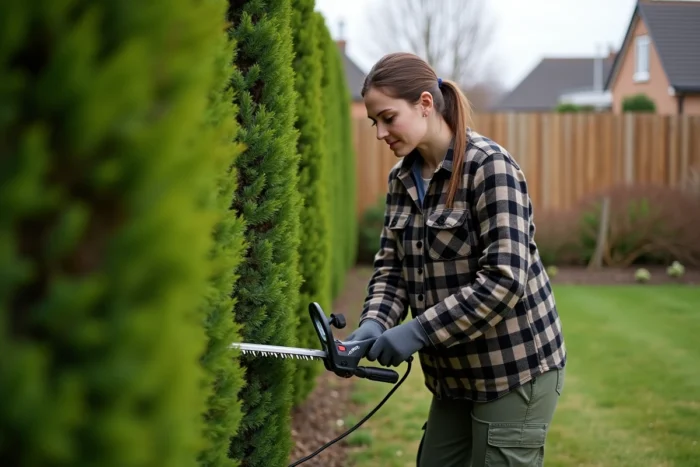
The generalization of high voltage battery platforms (type 56 V, brushless motor) has refocused the offering around 55 to 60 cm double-action blades. This format represents the current compromise between cutting reach, finish quality, and autonomy. The EGO 56 V model equipped with a 60.96 cm blade or the Bahco hedge trimmer with a 55.9 cm blade illustrate this convergence.
In this segment, double action (both blades move in opposite directions) reduces vibrations and improves cutting sharpness. The gain is not marginal: less vibration means less fatigue during long sessions, allowing the full length of the blade to be utilized without losing precision by the end of the day.
Why exceeding 60 cm on a handheld device poses problems
Beyond 60 cm, the weight of the blade shifts the center of gravity forward. On a handheld hedge trimmer held at arm’s length, every additional centimeter increases the tipping torque at the wrists. A fatigued operator compensates by raising their elbows, which degrades cutting horizontal alignment and produces waves on top of the hedge.
The 55-60 cm blade remains the best balance between reach and maneuverability for regular use on medium-height domestic hedges. Going beyond this is only justified for very long linear hedges, trimmed infrequently, where speed of passage takes precedence over finish.
Pole hedge trimmers and long blades: when length changes the logic
On telescopic pole models, the issue is reversed. The blade works at height or depth, often at a distance from the body. The blade length compensates for the inability to finely reposition the machine between each pass.
Today, blades reaching 1.80 m mounted on poles are commonly available, designed for work at height on large field hedges or driveways. This equipment allows covering the entire width of a tall hedge without a ladder, eliminating a considerable risk of falling.
- Blade of 40 to 50 cm on pole: suitable for narrow tall hedges, topiaries, shaped forms. Prioritizes precision over speed.
- Blade of 50 to 60 cm on pole: versatile, covers most tall residential hedges. The most common format in garden centers.
- Blade over 60 cm on pole or attached: reserved for field hedges, agricultural lines, or municipalities. The weight and inertia make handling delicate for an individual.
On a pole, the weight of the blade acts at the end of the lever. A long and heavy blade turns each pass into a core workout. For an individual who trims two or three times a year, we recommend staying under 60 cm of blade length on a pole.
Tooth spacing and cutting diameter: the forgotten criterion
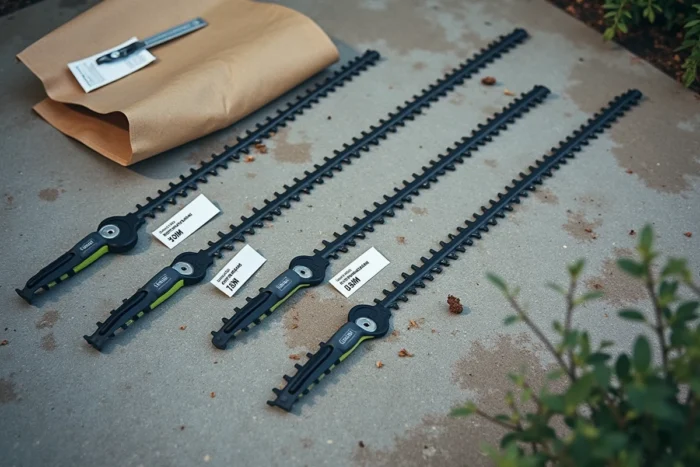
The blade length attracts attention, but the spacing between the teeth determines the maximum branch diameter accepted. A 60 cm blade with teeth spaced 28 mm does not cut the same as an identical blade with a spacing of 35 mm.
The wider the spacing, the thicker branches the machine can accept. In return, the finish on fine foliage will be less sharp: small shoots pass between the teeth without being cut. This is a direct trade-off between raw cutting capacity and finish quality.
- Narrow spacing (less than 25 mm): frequent maintenance trimming, fine foliage like boxwood, young privet. Neat finish.
- Medium spacing (25 to 33 mm): versatile, accepts semi-woody branches. The standard on most consumer hedge trimmers.
- Wide spacing (more than 33 mm): reshaping trimming, neglected hedges, woody branches. Secondary finish.
A powerful thermal hedge trimmer with wide spacing and a 60 cm blade covers dense and tall hedges in a minimum of passes. However, to sculpt a boxwood into a ball, the same equipment will be unusable. The right blade is the one that matches the type of trimming performed, not just the size of the hedge.
Choosing the blade length therefore involves crossing four data points: the height and thickness of the hedge, the dominant plant species, the expected trimming frequency, and the type of available motorization. An overly long blade on a weak motor produces mediocre results. A short blade on a powerful motor, on the other hand, offers a clean cut even on tough species, even if it means making multiple passes on large linear hedges.