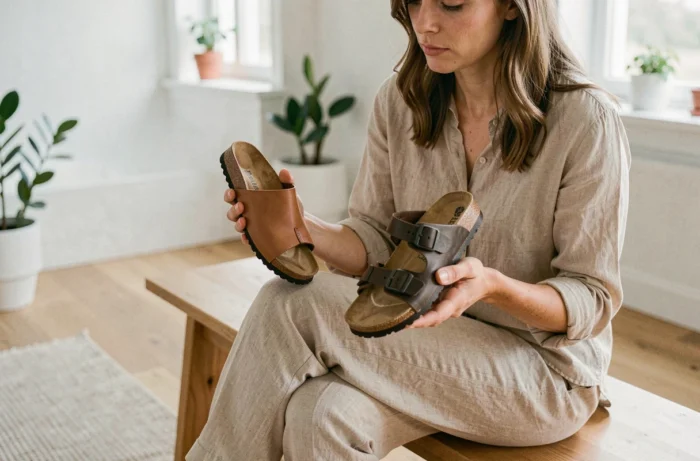
Comparing Billowy and Birkenstock comes down to measuring two opposing design philosophies applied to the same object: the sandal. The former focuses on flexibility and lightness, while the latter relies on a rigid cork anatomical sole. The price gap between the two brands is significant, but the question that structures this comparison lies elsewhere: what objective parameters (flexibility, arch support, width, materials) truly separate these two options in terms of comfort and foot health?
Cork anatomical sole versus flexible sole: what each construction implies for the foot
The Birkenstock sole rests on a footbed made of molded cork and latex, designed to conform to the arch of the foot with a pronounced relief under the medial arch. This relief provides firm support that limits foot collapse during prolonged walking.
The French Union for Foot Health (UFSP) notes that the support under the arch of a Birkenstock is not physiological, while acknowledging that this shoe can relieve tired feet from wearing very flat sandals. Podiatrist Fabien Beuzon, a member of the UFSP, specifies that if the wearer can tolerate it, it stands out from other open shoes by offering better comfort.
Billowy takes the opposite approach. The sole is flat, flexible, designed to accompany the natural movement of the foot rather than constrain it. The flex occurs at the forefoot, which aligns with current podiatric recommendations for growing feet.
For a reader seeking Billowy or Birkenstock reviews according to Stylissima, this opposition between structured rigidity and natural flexibility constitutes the primary sorting criterion.
Billowy or Birkenstock for children: podiatric recommendations make the call
Online comparisons often present this choice as a matter of taste or budget. Recent recommendations from podiatric associations steer the debate onto more precise ground.
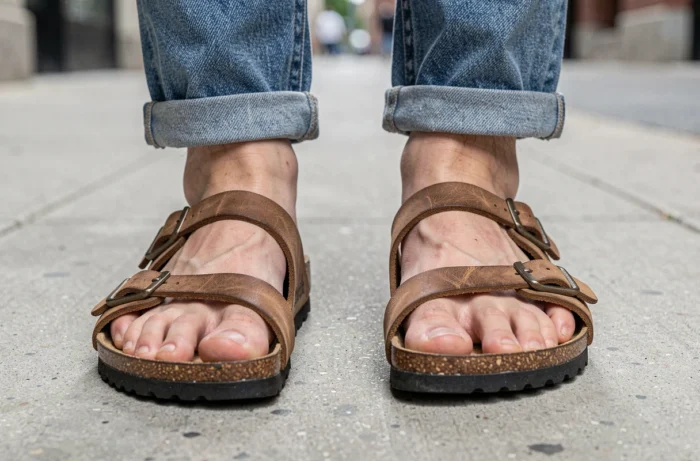
The American Podiatric Medical Association and the UFSP converge on one point: a child should wear lightweight, flexible, and flat-soled shoes, unless there is a specific pathology. The consensus recommends a margin of about one centimeter in front of the toes, a wide forefoot, and natural flex at the front of the foot.
These criteria align more with the Billowy construction than with that of an adult Birkenstock. Highly structured and rigid soles are discouraged for growing feet, as they can interfere with the muscular and proprioceptive development of the foot.
| Criterion | Billowy | Birkenstock (Arizona, Boston) |
|---|---|---|
| Sole | Flat, flexible | Anatomical cork, rigid |
| Forefoot flex | Yes | Limited |
| Forefoot width | Wide, non-compressive | Available in Regular and Narrow |
| Arch support | Minimal (flat) | Marked (relief under the arch) |
| Weight | Light | Heavier |
| Main target audience | Children, teenagers | Adults |
| Price range | Entry-level | Mid/high-end |
One element rarely mentioned in comparisons: walking barefoot remains the reference option for young children according to several podiatric recommendations, even before choosing a brand.
Foot width and choice between Regular and Narrow at Birkenstock
Birkenstock offers two widths on most of its models (Arizona, Boston): Regular for normal to wide feet, and Narrow for slimmer feet. This sizing system allows for an adjustment that Billowy does not offer with the same precision.
For an adult with a wide foot, the Regular model from Birkenstock provides a generous fit that avoids lateral compression. In contrast, a child whose foot is still developing generally does not need this type of calibration, as the flexibility of the material serves as the adaptation.
Criteria to check before choosing:
- Measure the width of the foot while standing and compare to each brand’s size charts, as a difference of a few millimeters can affect comfort over an entire day
- Check that the straps or bands are adjustable to compensate for variations in foot volume throughout the day
- Ensure that the forefoot is not laterally compressed, especially on the Narrow models of Birkenstock that can squeeze a standard foot
Materials and durability
The leather and cork used by Birkenstock provide superior durability compared to the synthetic materials of Billowy. The cork sole gradually molds to the wearer’s footprint after several weeks of wear, which enhances comfort over time.
Billowy uses lighter materials, suitable for rapid foot growth. A child who changes shoe size every few months does not benefit from a sole that takes time to form.
Everyday comfort: prolonged use and walking style
Over a full day of walking, Birkenstock provides support that flat sandals do not replicate. The relief under the arch reduces muscle fatigue in an adult whose arch is formed.
For moderate urban use or short outings, Billowy serves its purpose without overloading the foot. The lightness of the sandal promotes a natural gait, especially in children.
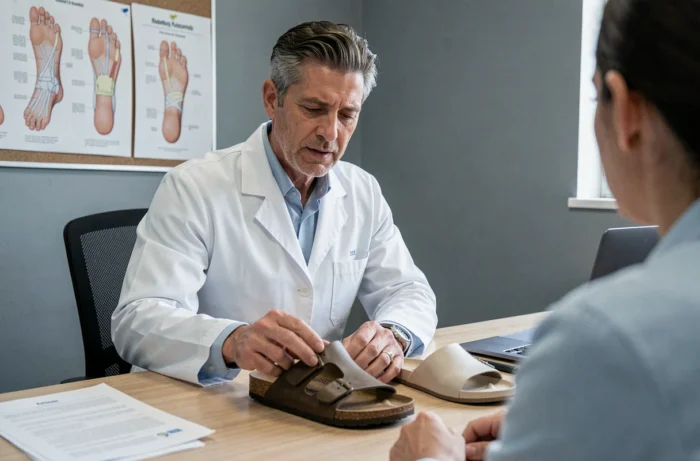
User feedback varies significantly depending on the profile: wearers accustomed to structured shoes find Birkenstock immediately comfortable, while those transitioning from a flat shoe to a Birkenstock describe a sometimes uncomfortable adjustment period. The relief of the Birkenstock sole does not suit all feet, and the UFSP recommends testing gradual wear before adopting it for daily use.
The choice between these two brands depends less on an overall value judgment than on three measurable variables: the age of the wearer, the morphology of their foot, and the duration of daily wear. For a growing child, podiatric data lean towards flexibility. For an adult walker, the structured support of the anatomical cork presents a documented advantage, provided the foot tolerates the relief.