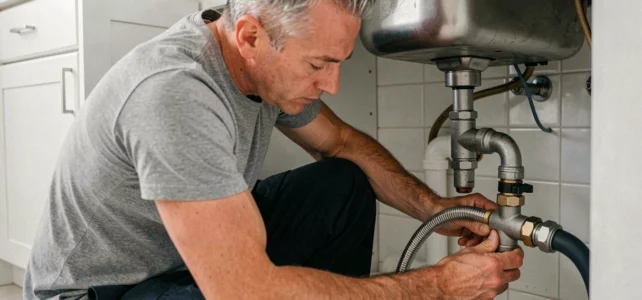
Connecting a dishwasher to the sink relies on three critical points: the tap on the cold water supply, the drainage connection to the siphon, and the management of the water seal to prevent any backflow. Connecting a dishwasher to the sink remains the most common configuration in French kitchens, where a dedicated water supply is often lacking.
Water seal and backflow prevention: the point that guides overlook
The dishwasher’s drainage hose does not connect arbitrarily to the sink’s siphon. Without precautions, wastewater from the sink can flow back into the machine at the end of the cycle, simply due to the principle of communicating vessels. This phenomenon causes persistent odors and, over time, clogs the drain pump.
The drainage hose must form a high loop before descending to the siphon. This loop, secured to the wall or under the countertop, creates a water seal that blocks backflow by gravity. We recommend positioning the highest point of the loop at least 65 cm off the ground, ideally at the level of the countertop.
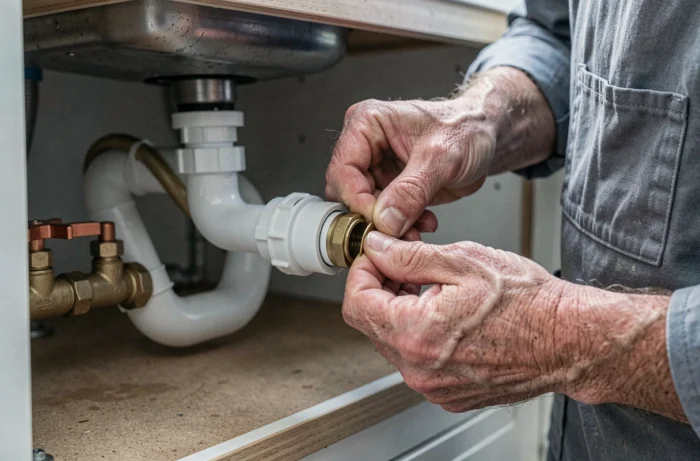
If the sink’s siphon does not have a side inlet for connecting the drainage, it must be replaced with a double connection siphon (one for the sink, one for the machine). A detailed guide explains how to connect a dishwasher to the sink by installing this type of connection on an existing siphon. Adding a non-return valve at the machine’s outlet remains an additional safety measure, but it does not eliminate the need for the high loop.

Connecting cold water supply to sink tap
The tap on the cold water supply of the sink requires a self-piercing tap or a T-connector. The self-piercing tap is installed without cutting the existing pipe, making it accessible without welding. However, its reduced passage section may limit the flow if the network pressure is already low.
The T-connector offers better flow. It requires cutting the supply, sawing the copper pipe, or disassembling the flexible hose, then connecting a dedicated shut-off tap for the dishwasher. This is the preferred solution for permanent installations.
Choosing the connection according to the existing material
- Exposed copper pipe: soldered T-connector or olive connection, followed by a quarter-turn tap in 3/4 inch (20/27) with a threaded 3/4 inch outlet for the machine’s flexible hose
- Stainless steel flexible under the sink: replacement with a female/female T-connector with integrated diversion, available in 15/21 or 20/27 depending on the existing diameter
- Pex or multilayer pipe: crimp or compression connection with diversion, depending on whether you have a crimping tool or not
In all cases, the supply hose supplied with the dishwasher screws onto the machine side and the tap side with a fiber washer or a rubber washer provided. Never replace a fiber washer with Teflon alone on a flat-faced connection, under penalty of leakage on the first tightening.
Drainage on sink siphon: diameters and compatibility
The drainage hose of the dishwasher has a standard outer diameter of 21 mm. The side connection of kitchen siphons is designed to accommodate this diameter, but there are variations depending on the manufacturers.
If the hose is too thin for the siphon’s fitting, a rubber reducing sleeve ensures sealing. A Serflex type clamp holds everything in place. We frequently observe installations where the hose is simply pushed into the siphon without tightening: this is a certain source of leakage as soon as the drain pump pushes water under pressure.
Position of the drainage hose relative to the wall
The path of the hose between the machine and the siphon should avoid right-angle bends, which create retention points. Favor a gentle and continuous slope towards the siphon. The hose runs behind the machine, rises in a high loop, then descends towards the side connection of the siphon.
Secure the hose to the wall with atlas clamps every 40 cm or so to prevent it from hanging and forming a water trap. A hose lying on the floor accumulates debris and eventually clogs.
Electrical supply and safety standards in the kitchen
The dishwasher connects to a dedicated power outlet, protected by a 30 mA residual current device. The NF C 15-100 standard requires that this outlet be located outside the protection zone around the sink. In practice, the outlet must be more than one meter from the water point, out of the splash zone.
An extension cord or power strip is not suitable for an appliance of this power. The cable section must correspond to the machine’s power, generally 2.5 mm² on a dedicated circuit protected by a 20 A circuit breaker.
Kitchen gray water: a regulatory framework to know
Since 2024, French regulations explicitly distinguish between classic gray water (shower, sink, washing machine) and kitchen gray water (sink and dishwasher). The latter, which is more loaded with fats and organic matter, falls under a much stricter regime regarding reuse.
Any reuse of water from the sink/dishwasher combination requires a prefectural authorization after advice from the Regional Health Agency, within an experimental framework valid for a maximum of 5 years, running until December 31, 2034. In summary, you cannot legally reuse the wastewater from your dishwasher to water the garden or supply the toilets without going through this procedure.
This point does not affect the connection itself, but it frames what you can do with the evacuated water. The drainage must connect to the collective or individual sanitation network, without illegal diversion.
A well-executed connection depends on three often-overlooked details: the high drainage loop, the tightening of the hose on the siphon, and the dedicated electrical circuit. Check the sealing of each connection by running an empty wash cycle before pushing the machine into its final position.